MinuteRead
30 min
Imagine standing in a room where every person believes they see reality clearly, yet no two people agree on what reality is. One person insists the only thing that matters is survival. Another argues that tradition and loyalty to the group come first. A third claims that power and dominance are simply how the world works. Someone else believes that order, rules, and discipline are the answer. Across the room, a voice says that achievement, innovation, and personal success are what truly count. A
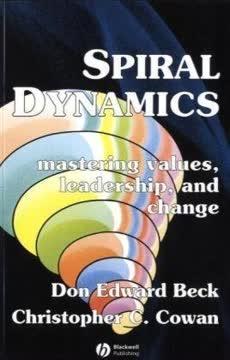
**Author:** Don Edward Beck with Christopher Cowan
**Estimated Reading Time:** 45 minutes
**What You'll Learn:** How human consciousness evolves through distinct value systems, why people see the world so differently, and how to communicate, lead, and solve problems across those differences.
**Who This Book Is For:** Leaders, educators, change agents, and anyone who has ever wondered why reasonable people can look at the same situation and reach completely different conclusions.
Imagine standing in a room where every person believes they see reality clearly, yet no two people agree on what reality is. One person insists the only thing that matters is survival. Another argues that tradition and loyalty to the group come first. A third claims that power and dominance are simply how the world works. Someone else believes that order, rules, and discipline are the answer. Across the room, a voice says that achievement, innovation, and personal success are what truly count. Another counters that equality, community, and caring for others should guide everything. And in the corner, a few people quietly suggest that all of these perspectives have value, depending on the circumstances. Most of us would look at this scene and pick a side. We would decide which person is right and which ones are wrong. We might even feel frustrated or angry at the people who see things differently. After all, how can someone not see what seems so obvious to us? Spiral Dynamics offers a different response. It suggests that every person in that room is right, but only partially. Each perspective represents a legitimate stage in the unfolding of human consciousness. Each emerged to solve problems that previous stages could not. Each has strengths that remain valuable and limitations that become apparent over time. The challenge is not to determine which perspective is correct, but to understand how all of them fit together in a larger pattern of human development. The story of Spiral Dynamics begins with Clare W. Graves, a psychology professor at Union College in New York. In the 1950s and 1960s, Graves was troubled by the competing theories of human behavior that dominated his field. Behaviorists claimed that humans were shaped entirely by their environment. Psychoanalysts insisted that unconscious drives ruled behavior. Humanistic psychologists argued that people were fundamentally oriented toward growth and self-actualization. Each school of thought had evidence. Each had passionate defenders. Yet none could fully explain the diversity of human behavior Graves observed. Rather than choosing among these theories, Graves asked a different question: What if each theory is correct for some people at some times? What if human psychology is not a single fixed system but an unfolding process? What if people develop through different ways of…
Continue reading in the MinuteRead app
Get the complete 30-minute summary of Spiral Dynamics
Get the complete summary in the appHuman consciousness evolves through identifiable stages called vMEMEs, each shaped by life conditions.
The eight levels are BEIGE (survival), PURPLE (belonging), RED (power), BLUE (order), ORANGE (achievement), GREEN (commu
Each new level includes and transcends the previous levels. We do not abandon earlier capacities. We integrate them.
First-tier thinking assumes one's own worldview is correct. Second-tier thinking recognizes the validity of all worldvie
Change happens when life conditions create the need, potential makes it possible, and barriers are removed.
The change process follows a pattern: stability, doubt, crisis, breakthrough, new stability.
"Spiral Dynamics" is a strong fit if you want practical ideas around psychology, business, philosophy, especially themes like human consciousness evolves through identifiable stages called vmemes, each shaped by life conditions; the eight levels are beige (survival), purple (belonging), red (power), blue (order), orange (achievement), green (commu. The MinuteRead summary distills these concepts into a focused read, whether you're deciding whether to buy the book or applying its lessons at work.
Prof. Don Edward Beck is a developmental psychologist and management consultant known for his work on Spiral Dynamics. He co-authored the book with Christopher Cowan, building upon the research of Clare W. Graves. Beck has applied the Spiral Dynamics model to various fields, including business, politics, and social development. He has worked on projects addressing societal issues in countries like South Africa and the Middle East. Prof. Don Edward Beck's approach combines theoretical understandi…
View all summaries by Don Edward BeckContinue Reading
Access the complete 30-minute summary and thousands more nonfiction books in the MinuteRead app.

Continue reading the complete summary in the MinuteRead app.