MinuteRead
30 min
Book summary
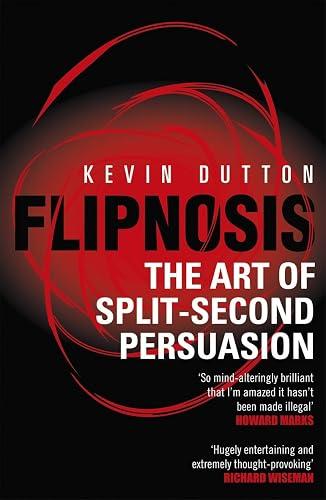
by Kevin Dutton
Premium summary · Opens in the app · 30 min read
There is a moment, brief and almost imperceptible, when a decision is made. It happens before conscious thought catches up. Before reasons are assembled. Before justification begins. In that moment, something shifts in the brain, and a person moves from resistance to acceptance, from doubt to belief, from no to yes.
**Author:** Kevin Dutton **Estimated Reading Time:** 42 minutes
**What You'll Learn**
The hidden psychological mechanisms that drive instant influence. You will discover why some people can change minds in seconds, how evolutionary wiring makes us susceptible to specific triggers, and how to ethically harness these forces in your own life.
**Who This Book Is For**
Anyone who has ever wondered why a baby can command a room without speaking. Anyone who negotiates, sells, leads, teaches, or simply wants to understand why they say yes when they meant to say no. This book is for people who want to see the invisible architecture of influence.
There is a moment, brief and almost imperceptible, when a decision is made. It happens before conscious thought catches up. Before reasons are assembled. Before justification begins. In that moment, something shifts in the brain, and a person moves from resistance to acceptance, from doubt to belief, from no to yes. Kevin Dutton spent years studying that moment. As a researcher at Oxford's Department of Experimental Psychology, he wanted to understand what happens in the space between stimulus and response, the split second where persuasion actually occurs. What he found challenges much of what we believe about influence. Most of us think persuasion is about argument. We believe that if we present the right facts, construct the right case, and deliver it with enough conviction, people will come around. We imagine influence as a kind of verbal chess match, where the most logical player wins. Dutton discovered something different. The most powerful forms of persuasion have almost nothing to do with argument. They operate below the level of conscious awareness, triggering ancient neural pathways that evolved long before language existed. They work not by convincing but by activating. Consider a mother calming a crying infant. She does not reason with the baby. She does not explain that everything will be fine. She holds the child close, makes soft sounds, and within moments the crying subsides. The persuasion is instantaneous, wordless, and nearly impossible to resist. This is split-second persuasion in its purest form. The same mechanisms operate in boardrooms and battlefields, in courtrooms and car showrooms. A skilled negotiator defuses a hostage situation with a well-timed joke. A salesperson closes a deal with an unexpected compliment. A politician wins votes with a confident smile rather than a detailed policy proposal. None of these moments involve logical argument. All of them change minds. Dutton's research took him into unusual places. He interviewed con artists and cult leaders. He studied psychopaths, not as criminals but as master persuaders whose cognitive traits give them remarkable influence abilities. He examined the tactics of elite military interrogators who face the ultimate…
Continue reading in the MinuteRead app
Get the complete 30-minute summary of Split-Second Persuasion
Get the complete summary in the appSplit-second persuasion operates below conscious awareness and is more powerful than deliberate argument.
SPICE: Simplicity, Perceived self-interest, Incongruity, Confidence, and Empathy are the five key elements of instant in
Belief is the default state. Your job is to prevent un-believing, not to build belief.
Simplicity wins. Easy-to-process information feels true.
Frame everything in terms of the other person's self-interest.
Break the script. The unexpected captures attention and opens minds.
"Split-Second Persuasion" is a strong fit if you want practical ideas around psychology, self help, business, especially themes like split-second persuasion operates below conscious awareness and is more powerful than deliberate argument; spice: simplicity, perceived self-interest, incongruity, confidence, and empathy are the five key elements of instant in. The MinuteRead summary distills these concepts into a focused read, whether you're deciding whether to buy the book or applying its lessons at work.
Motivated to turn hard-won expertise into something readers can use every day, Kevin Dutton wrote “Split-Second Persuasion” to distill the ideas behind the work into clear, actionable lessons. Through “Split-Second Persuasion”, Kevin Dutton distills the core ideas on psychology into lessons readers can absorb in a single short sitting. Readers turn to this work when they want Kevin Dutton's perspective on the subject without working through the entire original volume. The book is structured so e…
View all summaries by Kevin DuttonContinue Reading
Access the complete 30-minute summary and thousands more nonfiction books in the MinuteRead app.

Continue reading the complete summary in the MinuteRead app.