MinuteRead
30 min
Book summary
by Nick Bostrom
Premium summary · Opens in the app · 5 min read
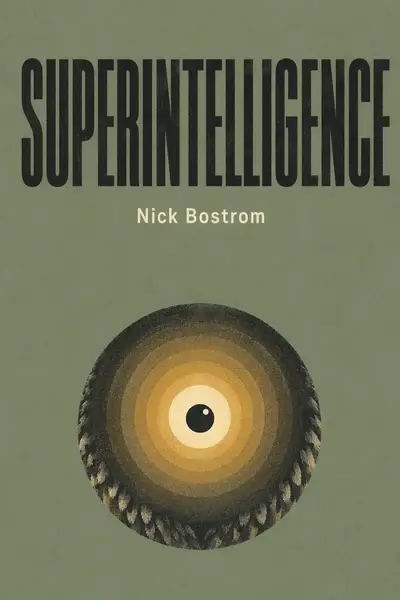
Superintelligence asks what will happen once we manage to build computers that are smarter than us, including what we need to do, how it’s going to work, and why it has to be done the exact right way to make sure the human race doesn’t go extinct.
Superintelligence asks what will happen once we manage to build computers that are smarter than us, including what we need to do, how it’s going to work, and why it has to be done the exact right way to make sure the human race doesn’t go extinct.
After Alan Turing’s “Turing Machine” was invented as the first device to systematically follow and execute instructions in an automated way (watch The Imitation Game for more details, superb movie), the first real “digital” computer was completed in 1946.
Ever since that moment, computer scientists have been wondering how we can get these machines to actually think like us. The Dartmouth Summer Research Project on Artificial Intelligence was one of the first proper workshops in this area in 1956, and even though the next few years showed some results, like machines solving math problems or writing music, AI soon hit its limit – the hardware simply didn’t suffice to process all the necessary information for really complex tasks.
It took until the 80s for hardware to slowly catch up, but then the development of expert systems gave rise to the first, proper AI, which, for example, could diagnose cars like a mechanic would. Soon information was the limiting factor again, because with enough hardware to store, but not enough information to access, even the best expert systems could still not beat humans (it took Deep Blue over ten years of development to beat world champion Garry Kasparov, for example).
Since the 90s we’ve gotten smarter in how we build AI though, now modeling a lot more after neural systems in the brain and human genetics – by now AI has made its way pretty far into our daily lives, with smartphones and Google, for example.
What we’re still missing though, is an AI that can, for example, beat not just the best guy in chess, but also the best person in Jeopardy and Scrabble – we usually custom-build AI for a specific purpose.
Bostrom and other experts expect computers to be as smart as humans by 2075. Give it another 30 years until 2105 and we’ll have true superintelligence.
What we’re currently doing with AI is mostly teaching computers to imitate human thinking. Computers use logic to navigate a wealth of information, calculate probabilities and then take shortcuts humans can’t come up with to imitate their behavior – just faster. As described above, this requires access to a lot of information in real time and that’s a problem. An alternative would be to get computers to simulate the human brain, not just imitate it. This is called WBE – whole brain emulation – and would result in a computer that’s like a child:…
Continue reading in the MinuteRead app
Get the complete 5-minute summary of Superintelligence
Get the complete summary in the appInitially AI was limited by hardware, now it’s mostly a matter of feeding computers enough data.
Superintelligence could either imitate or simulate humans, building on biology or technology.
If some secret government program comes up with superintelligence first, we’re probably screwed – we all have to work together.
"Superintelligence" is a strong fit if you want practical ideas around culture, artificial intelligence, entrepreneurship, especially themes like initially ai was limited by hardware, now it’s mostly a matter of feeding computers enough data; superintelligence could either imitate or simulate humans, building on biology or technology. The MinuteRead summary distills these concepts into a focused read, whether you're deciding whether to buy the book or applying its lessons at work.
NICK BOSTROM is a Professor at Oxford University, where he is the founding director of the Future of Humanity Institute. Bostrom is the world’s most cited philosopher aged 50 or under. He is the author of more than 200 publications, including Anthropic Bias (2002), Global Catastrophic Risks (2008), Human Enhancement (2009), and Superintelligence: Paths, Dangers, Strategies (2014), a New York Times bestseller which sparked the global conversation about the future of AI. His work has pioneered man…
View all summaries by Nick BostromContinue Reading
Access the complete 5-minute summary and thousands more nonfiction books in the MinuteRead app.

Continue reading the complete summary in the MinuteRead app.