MinuteRead
30 min
Book summary
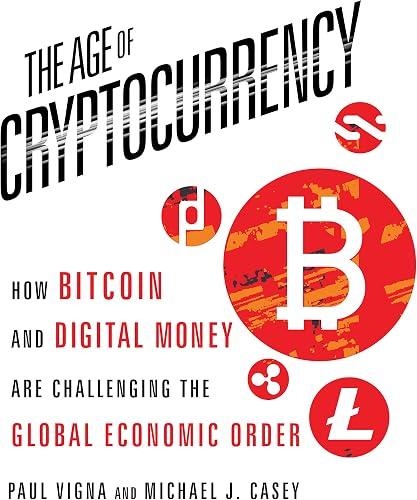
by Paul Vigna
Premium summary · Opens in the app · 5 min read
The Age Of Cryptocurrency explains the past, present, and future of Bitcoin, including its benefits and drawbacks, how it aligns with the definition of money well enough to be its own currency, how it and other cryptocurrencies will change our economy and the entire world.
The Age Of Cryptocurrency explains the past, present, and future of Bitcoin, including its benefits and drawbacks, how it aligns with the definition of money well enough to be its own currency, how it and other cryptocurrencies will change our economy and the entire world.
Some people have a hard time viewing it as “real” money because they can’t see it.
But those people just need to do their research to see that it already has proven itself as a viable currency. It works for the same reason cash does– people have trust in its value. As it becomes more widely accepted as a form of payment, people are trusting it even more.
We can see this increased trust if we look at Bitcoin’s rising price. In the first three months of 2013, it rose a staggering 800 percent in value from $129 to $1,165. One of the reasons for this trust is because Bitcoin isn’t run by a central bank like other currencies, so it can’t be controlled or manipulated.
So is it real money? The answer is yes because many places now take it as a form of payment. But it did take some time to build trust enough for people to accept it.
In the first year of Bitcoin, a coder named Lazlo Hanyecz owned about half of the existing Bitcoin. The only problem was that no one would accept it. So when he wanted to buy two Papa John’s pizzas he had to turn to his Bitcoin buddies and pay one of them 10,000 Bitcoin to buy them for him with a credit card.
At the time that amount of Bitcoin was worth about $41. Now those 10,000 Bitcoin would be worth $5 million. Many retailers now accept Bitcoin and that number is growing all the time.
You may be wondering where Bitcoins come from because not just anyone can create them or they’d be worthless. Like gold, Bitcoin has to be “mined.” But unlike mining gold, you don’t need pickaxes, you need a powerful computer. Computers mine Bitcoins by solving ultra-complex math problems. Solving these problems takes a huge amount of computational power. After solving the math problem, a Bitcoin is given as a reward and a new problem is issued. So the faster and more powerful your computer is, the more likely you will be able to mine a Bitcoin. Only 21 million Bitcoin will ever be released, so there is incentive to mine as many as possible before they run out. Estimates say that all Bitcoin will be mined by 2040. Every time a new Bitcoin comes out, the blockchain gets an update. The blockchain is a public record of all the Bitcoins…
Continue reading in the MinuteRead app
Get the complete 5-minute summary of The Age Of Cryptocurrency
Get the complete summary in the appMoney and Bitcoin are equivalent because we can use both to exchange goods and services.
To “mine” a Bitcoin, you have to solve a complicated math problem, and every Bitcoin transaction is within the blockchain.
Bitcoin has a lot of benefits, but there are some drawbacks we must consider as well.
"The Age Of Cryptocurrency" is a strong fit if you want practical ideas around culture, economics, future, especially themes like money and bitcoin are equivalent because we can use both to exchange goods and services; to “mine” a bitcoin, you have to solve a complicated math problem, and every bitcoin transaction is within the blockchain. The MinuteRead summary distills these concepts into a focused read, whether you're deciding whether to buy the book or applying its lessons at work.
Paul Vigna is an author and former reporter for The Wall Street Journal, and has been a journalist for more than 30 years, as a reporter, editor, and photographer. He currently writes the Substack newsletter PofV and posts on TikTok under his name. Vigna covered the equity markets and economics for the journal across its blogs, podcasts, and live video programs. In 2013 he began writing about bitcoin, pioneered coverage of bitcoin and the cryptocurrency sector. In 2015, he co-wrote "The Age of …
View all summaries by Paul VignaContinue Reading
Access the complete 5-minute summary and thousands more nonfiction books in the MinuteRead app.

Continue reading the complete summary in the MinuteRead app.