MinuteRead
30 min
Book summary
Premium summary · Opens in the app · 30 min read
Maria Konnikova did not set out to become a poker player. She was a writer for The New Yorker with a PhD in psychology from Columbia University. She had spent years studying how the human mind works, how we make decisions, and why we so often get things wrong. She had written books about con artists and the psychology of deception. She was comfortable in the world of ideas, of academic research, of careful analysis.
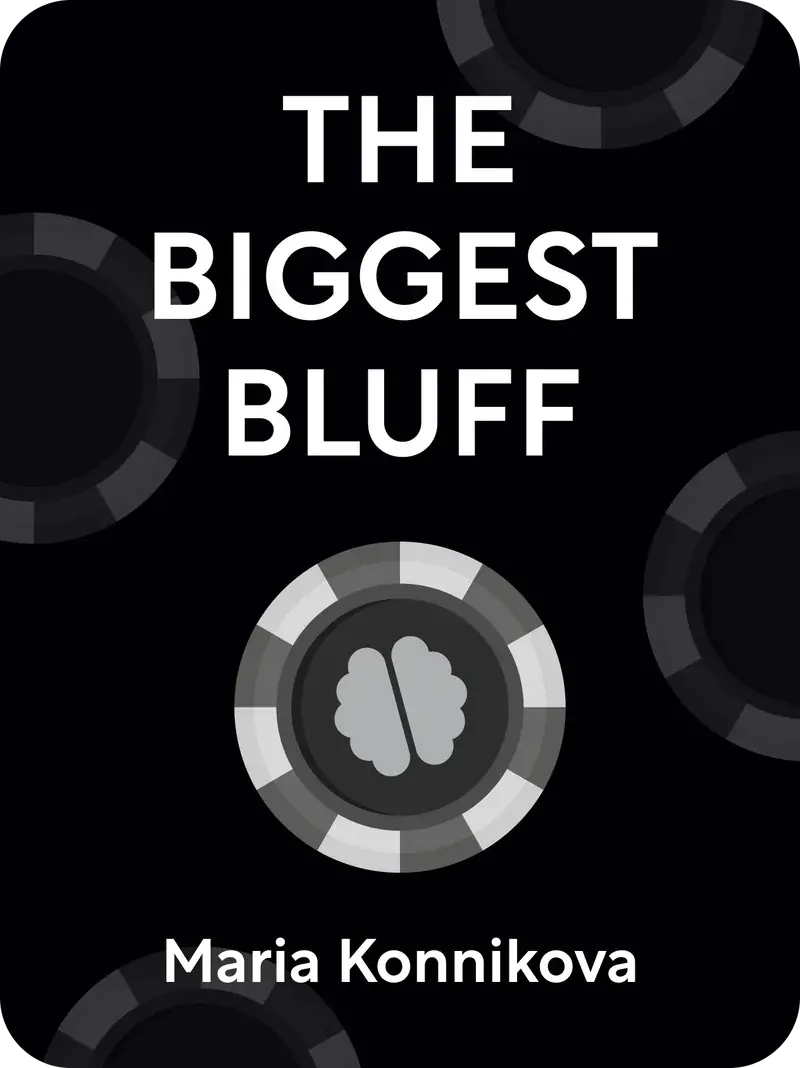
**Author:** Maria Konnikova
**Estimated Reading Time:** 45 minutes
**What You'll Learn:**
- Why poker is the perfect laboratory for understanding human decision-making - How to separate what you can control from what you cannot - Why losing well matters more than winning often - How to recognize and manage your emotional blind spots - What a psychologist learned about life from a year immersed in professional poker
**Who This Book Is For:**
Anyone who has ever made a decision under uncertainty, which is to say everyone. Whether you are navigating a career change, managing investments, building relationships, or simply trying to think more clearly in a noisy world, this book offers a framework for understanding the delicate dance between skill and chance that shapes every outcome in life.
Maria Konnikova did not set out to become a poker player. She was a writer for The New Yorker with a PhD in psychology from Columbia University. She had spent years studying how the human mind works, how we make decisions, and why we so often get things wrong. She had written books about con artists and the psychology of deception. She was comfortable in the world of ideas, of academic research, of careful analysis. Then she read a book about the role of chance in life, and something shifted. The book argued that we consistently overestimate how much control we have over outcomes. We attribute success to skill and failure to bad luck. We see patterns where none exist. We believe we understand systems that are far too complex for any human mind to fully grasp. Konnikova wanted to understand this phenomenon from the inside. She wanted to find a domain where the tension between skill and chance was not theoretical but immediate, where decisions had real consequences, and where the feedback was fast enough to learn from. She considered chess, but chess is a game of complete information. Both players see the same board. There is no hidden element, no uncertainty about what the other person holds. Chess is a pure test of calculation and pattern recognition. Poker was different. In poker, you never have complete information. You know your own cards, but you do not know what your opponents hold. You do not know what cards will come next. You do not know how others will react to your bets. Every decision is made under conditions of uncertainty. Every hand is a miniature experiment in decision-making under pressure. There was one problem: Konnikova had never played poker. She did not know the rules. She had never placed a bet. She was, by her own admission, perhaps the least likely person to enter the world of professional poker. She was…
Continue reading in the MinuteRead app
Get the complete 30-minute summary of The Biggest Bluff
Get the complete summary in the appJudge decisions by their process, not their outcomes.
You control your choices, not your results.
Life is a game of incomplete information. Act anyway.
Catch tilt early. Create space between emotion and action.
Question the stories you tell yourself.
Think in probabilities, not certainties.
"The Biggest Bluff" is a strong fit if you want practical ideas around psychology, memoir, self help, especially themes like judge decisions by their process, not their outcomes; you control your choices, not your results. The MinuteRead summary distills these concepts into a focused read, whether you're deciding whether to buy the book or applying its lessons at work.
Maria Konnikova is a writer for The New Yorker and holds a PhD in Psychology from Columbia University. Her academic background informs her approach to poker, which she undertook as a novice for this book project. Konnikova's writing style blends personal narrative with scientific insights, making complex psychological concepts accessible to a general audience. Her previous works have also explored the intersection of psychology and everyday life. Konnikova's journey from complete poker novice to…
View all summaries by Maria KonnikovaContinue Reading
Access the complete 30-minute summary and thousands more nonfiction books in the MinuteRead app.

Continue reading the complete summary in the MinuteRead app.