MinuteRead
30 min
Book summary
by HUNGRY MINDS
Premium summary · Opens in the app · 5 min read
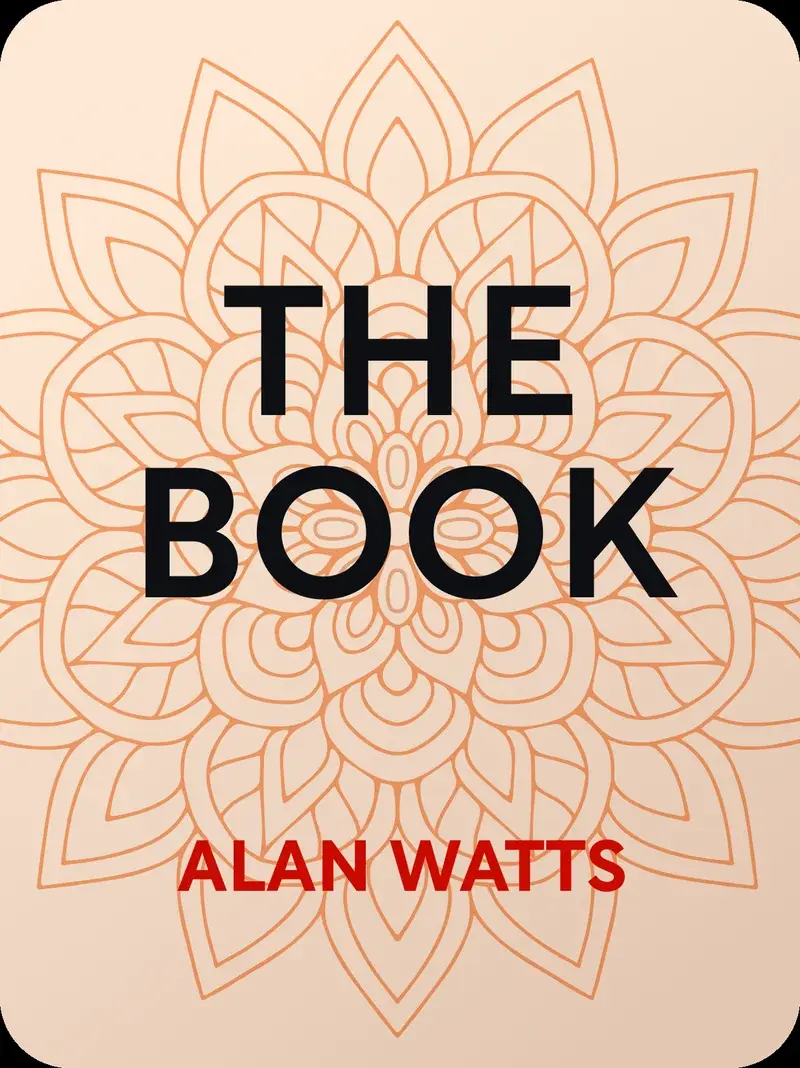
The Book is a spiritual exploration of true human nature and our place in the universe that challenges wide-spread but often misled beliefs.
The Book is a spiritual exploration of true human nature and our place in the universe that challenges wide-spread but often misled beliefs.
The first fallacy Watts point us to is that most people perceive themselves as entities separated from the rest of the world. In his own words:
This way of looking at ourselves has far-reaching consequences. It often leads us to put artificial barriers between ourselves and others and fight with reality to “get what we want.” The perceived opposition between the “I” and everything else is very apparent in our language. Just consider customary phrases like “you must face reality” or “the conquest of nature.”
Watts wants you to see through this illusion of “me against the world.” He explains how we are all intrinsic parts of the whole universe. The unity and interconnectedness with our environment is our true nature and identity – so it should have priority over the illusion of separation that our physical bodies reinforce.
The Book reminds us that the Earth grows people, just like it grows forests or creates waves. That simple realization is the reason we should consider ourselves as interdependent with the world – rather than independent from it.
Most of us perceive the world in binary terms. We recognize day based on its opposition to night – and the other way around. This kind of labeling leads us to believe that things are indeed black or white in this world. Such a biased perception is often taken for granted and not even verbalized. That’s just how everyone sees the world – and so it doesn’t cross our minds to question it. Germans refer to such deeply embedded assumptions as Hintergedanken, which literally translates as “behind the thoughts.” One of the widespread Hintergedanken is that life works according to the law of cause and effect. Watts claims that this law is nothing but an illusion. However, once embraced, it distorts our image of reality in a way that continuously reinforces what we want to see. To illustrate this, let’s compare the “cause and effect” bias to a little hole in a fence, through which you observe the world. Let’s also imagine you have never seen a cat before in your life. As you look through the hole, a cat passes by. You see its head first. Then, there comes the body, followed by the tail. If you observe long enough, the cat will pass by several times and you will conclude that the view of the body is obviously an effect of the head. Simultaneously, it gives the cause for the tail to emerge a moment later. As long as you look through the hole, it will never occur…
Continue reading in the MinuteRead app
Get the complete 5-minute summary of The Book
Get the complete summary in the appYou are part of a bigger whole, rather than a lonely island.
Causality of events is a kind of cognitive bias.
Death is an opportunity, not a threat.
"The Book" is a strong fit if you want practical ideas around culture, mindfulness, philosophy, especially themes like you are part of a bigger whole, rather than a lonely island; causality of events is a kind of cognitive bias. The MinuteRead summary distills these concepts into a focused read, whether you're deciding whether to buy the book or applying its lessons at work.
"Hungry Minds" is a collective intellect hailing from the planet Earth. It comprises individuals from different countries around the world who are united by curiosity and a passion for the beautiful. Together, they create unique art books for you. Our books do not have a single specific author or artist; it's always a multitude of people, each of whom contributes a piece of their talent and imagination. We hope you will like them!
View all summaries by HUNGRY MINDSContinue Reading
Access the complete 5-minute summary and thousands more nonfiction books in the MinuteRead app.

Continue reading the complete summary in the MinuteRead app.