MinuteRead
30 min
Book summary
by Gad Saad
Premium summary · Opens in the app · 30 min read
Every day, you make hundreds of consumption decisions. You choose what to eat for breakfast, what clothes to wear, what music to listen to, what gifts to buy for friends, and what products to purchase for your home. Most of the time, you believe these choices reflect your personal taste, your cultural background, or your individual preferences. You think of yourself as a rational consumer making deliberate decisions.
**Author:** Gad Saad
**Estimated Reading Time:** 45 minutes
**What You'll Learn:**
- Why your food cravings, shopping habits, and cultural tastes are not accidents - How evolutionary forces shape everything from gift-giving to luxury purchases - Why advertising works on universal psychological triggers - What religion, self-help, and pop culture reveal about human nature - How to apply evolutionary thinking to make better decisions in your personal and professional life
**Who This Book Is For:**
Anyone who has ever wondered why they crave certain foods, feel drawn to particular products, or find themselves making purchases that seem irrational. This book is for marketers seeking deeper insight into consumer behavior, for business leaders wanting to understand their customers, and for curious readers who want to understand the hidden biological forces driving their daily choices.
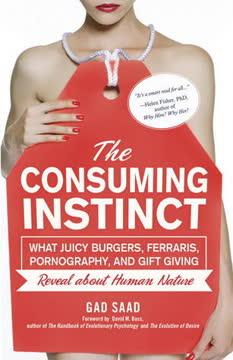
Every day, you make hundreds of consumption decisions. You choose what to eat for breakfast, what clothes to wear, what music to listen to, what gifts to buy for friends, and what products to purchase for your home. Most of the time, you believe these choices reflect your personal taste, your cultural background, or your individual preferences. You think of yourself as a rational consumer making deliberate decisions. But what if that belief is wrong? What if the real drivers of your consumption behavior are far older and far deeper than you ever imagined? What if your preference for fatty foods, your attraction to luxury brands, your choice of romantic partners, and even your taste in movies are all shaped by evolutionary forces that developed hundreds of thousands of years ago on the African savanna? This is the central argument of Gad Saad's groundbreaking book, The Consuming Instinct. Saad, a professor of marketing at Concordia University and a pioneer in the field of evolutionary behavioral sciences, argues that consumer behavior cannot be fully understood without recognizing its biological and evolutionary foundations. The human mind, he contends, is not a blank slate shaped entirely by culture and environment. It is a product of natural selection, equipped with psychological adaptations that evolved to solve specific survival and reproductive challenges faced by our ancestors. The problem with most approaches to consumer behavior is that they treat human beings as if they were born yesterday. Traditional marketing theories focus on cultural differences, social influences, and cognitive biases without asking the deeper question: Why do these patterns exist in the first place? Why do humans across every culture on Earth show similar preferences for certain types of food, certain facial features, certain status symbols, and certain narrative themes? The answer, Saad argues, lies in evolution. Our brains were shaped by the same forces that shaped our bodies. Just as we have evolved…
Continue reading in the MinuteRead app
Get the complete 30-minute summary of Consuming Instinct
Get the complete summary in the appConsumer behavior is biological behavior, shaped by the same evolutionary forces that shaped our bodies.
Our food preferences for fat, sugar, and salt evolved as adaptations to ancestral food scarcity and now contribute to ob
Men and women consume differently because they faced different reproductive challenges, with women investing in appearan
Gift-giving and other social consumption behaviors are forms of reciprocal altruism that strengthen social bonds.
Cultural products like songs, movies, and books contain universal themes that reveal evolved human preferences.
Effective advertising taps into evolved psychological triggers like attractive endorsers, fear appeals, and social proof
"Consuming Instinct" is a strong fit if you want practical ideas around psychology, science, business, especially themes like consumer behavior is biological behavior, shaped by the same evolutionary forces that shaped our bodies; our food preferences for fat, sugar, and salt evolved as adaptations to ancestral food scarcity and now contribute to ob. The MinuteRead summary distills these concepts into a focused read, whether you're deciding whether to buy the book or applying its lessons at work.
Gad Saad is a Professor of Marketing at Concordia University, holding the Research Chair in Evolutionary Behavioral Sciences and Darwinian Consumption. He has authored several books, including "The Consuming Instinct," which explores consumer behavior through an evolutionary lens. Saad has published extensively in marketing, psychology, and evolutionary theory. He has received numerous awards for his research and teaching. Saad is known for his work applying evolutionary psychology to business a…
View all summaries by Gad SaadContinue Reading
Access the complete 30-minute summary and thousands more nonfiction books in the MinuteRead app.

Continue reading the complete summary in the MinuteRead app.