MinuteRead
30 min
Book summary
Premium summary · Opens in the app · 30 min read
Every day, governments make decisions that determine who lives and who dies. They decide whether a new chemical can enter the marketplace, how much pollution a factory can emit, what safety features cars must have, and which drugs patients can access. These decisions affect hundreds of millions of people. They involve staggering sums of money. And for most of modern history, they were made without any systematic effort to measure their consequences.
**Author:** Cass R. Sunstein **Estimated Reading Time:** 45 minutes
**What You'll Learn:**
- How a quiet revolution transformed the way governments make decisions - Why putting numbers on human life and dignity is both necessary and controversial - The hidden cognitive biases that distort our judgment about risk - How cost-benefit analysis can bridge political divides - The limits of quantification and when other values must prevail - Practical frameworks for making better decisions in your own life
**Who This Book Is For:**
This book is for anyone who has ever wondered how governments decide which risks to regulate and which to leave alone. It is for readers frustrated by political debates that seem to generate more heat than light. It is for professionals who make consequential decisions under uncertainty. And it is for citizens who want to understand the hidden machinery of modern governance.
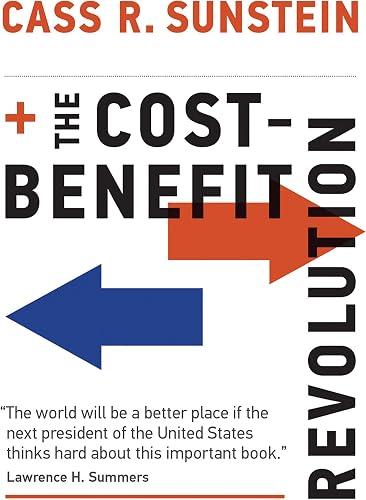
Every day, governments make decisions that determine who lives and who dies. They decide whether a new chemical can enter the marketplace, how much pollution a factory can emit, what safety features cars must have, and which drugs patients can access. These decisions affect hundreds of millions of people. They involve staggering sums of money. And for most of modern history, they were made without any systematic effort to measure their consequences. This is the problem Cass Sunstein confronts in The Cost-Benefit Revolution. The book tells the story of how a simple idea transformed the administrative state: before regulating, count the costs and count the benefits. Compare them. Choose the path that makes people better off. The idea sounds obvious. Almost trivial. Yet it sparked a revolution. Before the 1980s, American regulatory agencies operated largely on instinct, political pressure, and good intentions. When Congress passed a law requiring cleaner air, agencies wrote rules. When the public demanded safer workplaces, regulators imposed standards. The question of whether a rule would cost $10 million or $10 billion rarely entered the conversation. The question of whether it would save ten lives or ten thousand was often treated as unanswerable, even unaskable. The result was predictable. Some regulations saved many lives at modest cost. Others cost enormous sums while achieving almost nothing. No one knew which was which because no one was systematically counting. The revolution changed that. It began with an executive order signed by Ronald Reagan in 1981, requiring agencies to analyze the costs and benefits of significant regulations before issuing them. The order was controversial. Critics on the left saw it as a tool for blocking environmental and worker protections. Critics on the right saw it as an expansion of bureaucratic power. Both were partly right. But something unexpected happened over the following decades: every subsequent…
Continue reading in the MinuteRead app
Get the complete 30-minute summary of The Cost-Benefit Revolution
Get the complete summary in the appCost-benefit analysis is a method for making decisions based on evidence about consequences rather than intuition or ide
The value of a statistical life, currently about $9 million, is a measure of how people value risk reduction, not the va
The knowledge problem means that regulators often do not know enough to make good decisions, so humility and adaptabilit
Moral commitments are real sources of welfare and should be included in analysis, but some commitments, like racial disc
The precautionary principle is often applied selectively and, if applied consistently, would paralyze all action.
Free speech requires special protection because the costs of over-restriction are asymmetric.
"The Cost-Benefit Revolution" is a strong fit if you want practical ideas around economics, politics, law, especially themes like cost-benefit analysis is a method for making decisions based on evidence about consequences rather than intuition or ide; the value of a statistical life, currently about $9 million, is a measure of how people value risk reduction, not the va. The MinuteRead summary distills these concepts into a focused read, whether you're deciding whether to buy the book or applying its lessons at work.
Motivated to help readers with the cost-benefit revolution defies the wishes of the left and the right, Cass R. Sunstein wrote “The Cost-Benefit Revolution” to package those ideas for a fast, focused read. In “The Cost-Benefit Revolution”, Cass R. Sunstein focuses on the cost-benefit revolution defies the wishes of the left and the right. Through “The Cost-Benefit Revolution”, Cass R. Sunstein distills the core ideas on economics into lessons readers can absorb in a single short sitting. Readers…
View all summaries by Cass R. SunsteinContinue Reading
Access the complete 30-minute summary and thousands more nonfiction books in the MinuteRead app.

Continue reading the complete summary in the MinuteRead app.