MinuteRead
30 min
Book summary
Premium summary · Opens in the app · 30 min read
In 2005, a panel of experts convened by the magazine *Foreign Policy* attempted to predict the future. They were asked to forecast major world events over the coming decade. Their predictions covered wars, economic shifts, technological breakthroughs, and political transformations. When researchers later reviewed their accuracy, the results were sobering. The experts performed barely better than random guessing. Some performed worse.
**Author:** Leonard Mlodinow
**Estimated Reading Time:** 45 minutes
**What You'll Learn:** Why randomness shapes far more of your life than you realize, how your brain systematically misreads chance, and how understanding probability can help you make better decisions, judge people more fairly, and live with greater resilience.
**Who This Book Is For:** Anyone who has ever wondered why talented people fail, why mediocre efforts sometimes succeed, why experts so often get things wrong, or why life feels less predictable than it should. This book is for people who want to see the hidden architecture of chance that quietly governs so much of what happens to us.
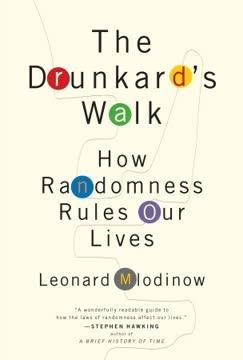
In 2005, a panel of experts convened by the magazine *Foreign Policy* attempted to predict the future. They were asked to forecast major world events over the coming decade. Their predictions covered wars, economic shifts, technological breakthroughs, and political transformations. When researchers later reviewed their accuracy, the results were sobering. The experts performed barely better than random guessing. Some performed worse. This is not an isolated finding. Studies of stock market analysts, political pundits, sports forecasters, and even medical diagnosticians reveal a consistent pattern. People who are paid to predict the future are often no better at it than chance would allow. Yet we continue to trust predictions, build careers on forecasts, and feel shocked when the unexpected happens. Leonard Mlodinow wrote *The Drunkard's Walk* to explain why. The answer is not that experts are foolish or that prediction is impossible. The answer is that randomness plays a far larger role in life than most of us are willing to accept. We live in a probabilistic universe, but we think in deterministic stories. We crave explanations, patterns, and narratives. We want the world to make sense. When it does not, we invent reasons anyway. The title of the book comes from a mathematical concept called a random walk. Imagine a drunkard leaving a lamppost at night. Each step he takes is random. He might stagger left, then right, then forward, then back. After many steps, where will he be? The mathematics of random walks tells us that his position is unpredictable in the short term but follows predictable patterns over many trials. The same is true of life. Individual events are unpredictable. Careers, markets, relationships, and reputations all follow paths shaped by chance. But over large numbers of people and long periods of time, patterns emerge. Mlodinow is uniquely positioned to tell this story. He is a theoretical physicist who has worked at Caltech and the Max Planck Institute. He has written for television, including *Star Trek: The Next Generation*, and co-authored books with Stephen Hawking. He understands both the mathematics of probability and…
Continue reading in the MinuteRead app
Get the complete 30-minute summary of The Drunkard's Walk
Get the complete summary in the appRandomness plays a much larger role in life than most people realize.
Random events cluster. Clusters do not necessarily mean causation.
Human intuition is systematically bad at probability.
The law of large numbers applies to large samples, not small ones.
Regression to the mean explains why extreme outcomes fade.
Confirmation bias, hindsight bias, and the illusion of control distort our judgment.
"The Drunkard's Walk" is a strong fit if you want practical ideas around science, psychology, mathematics, especially themes like randomness plays a much larger role in life than most people realize; random events cluster. clusters do not necessarily mean causation. The MinuteRead summary distills these concepts into a focused read, whether you're deciding whether to buy the book or applying its lessons at work.
Leonard Mlodinow is a theoretical physicist, mathematician, and author known for his work in physics and popular science writing. He has contributed to the large N expansion method and quantum theory of light in dielectrics. Mlodinow has authored several New York Times bestsellers, including "The Drunkard's Walk" and "The Grand Design" (co-authored with Stephen Hawking). His books explore complex scientific concepts for general audiences, covering topics like randomness, the origins of the unive…
View all summaries by Leonard MlodinowContinue Reading
Access the complete 30-minute summary and thousands more nonfiction books in the MinuteRead app.

Continue reading the complete summary in the MinuteRead app.