MinuteRead
30 min
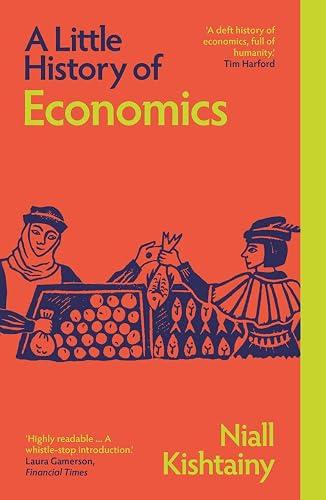
Book summary
by Niall Kishtainy
Premium summary · Opens in the app · 30 min read
Every day you make economic decisions. You decide whether to buy a coffee or save the money. You choose between taking a job that pays more or one that offers more satisfaction. You weigh whether to invest in education or start working immediately. These choices feel personal, but they connect to something much larger: a vast system of production, exchange, and consumption that determines the material conditions of human life.
**Author:** Niall Kishtainy
**Estimated Reading Time:** 45 minutes
**What You'll Learn:** How economic thinking evolved from ancient Greece to the modern era, why different schools of thought emerged, and how the major ideas in economics shape the world you live in today.
**Who This Book Is For:** Anyone who wants to understand the forces that determine wealth, poverty, prices, jobs, and financial stability without getting lost in mathematical formulas or academic jargon.
Every day you make economic decisions. You decide whether to buy a coffee or save the money. You choose between taking a job that pays more or one that offers more satisfaction. You weigh whether to invest in education or start working immediately. These choices feel personal, but they connect to something much larger: a vast system of production, exchange, and consumption that determines the material conditions of human life. Most people experience economics as something that happens to them. Prices rise. Jobs disappear. Recessions strike. Financial markets crash. Governments announce policies that seem distant and technical. The language of economics, filled with terms like aggregate demand, comparative advantage, and monetary policy, can feel like a foreign tongue designed to exclude ordinary people from important conversations. This book exists to change that. Niall Kishtainy argues that economics is not a dry technical discipline reserved for specialists. It is a story about how human beings have tried to understand and organize the material world. It is a history of ideas, filled with intellectual revolutions, bitter disputes, and unexpected insights. The great economic thinkers were not merely mathematicians or bureaucrats. They were philosophers, moralists, revolutionaries, and reformers who grappled with the most urgent questions of their time. The problem is that most people never learn this story. They encounter economics as a set of abstract models and intimidating equations. They are told that economics is the science of rational choice, but they know from their own experience that human beings are often irrational, emotional, and impulsive. They sense that something is missing from the standard account, but they lack the vocabulary to articulate what it is. Kishtainy's approach is different. He presents economics as a living tradition of inquiry, one that has evolved through centuries of debate and real-world experimentation. He shows that the questions economists ask today are often the same questions that troubled Aristotle, Adam Smith, Karl Marx, and John Maynard Keynes. What makes a society wealthy? What is a fair price? Why do markets fail? What role should government play in economic life? Understanding this history matters because economic ideas have consequences. When policymakers embraced Keynesian ideas after the Great Depression, they built welfare states and committed to full employment. When they turned to monetarism in the…
Continue reading in the MinuteRead app
Get the complete 30-minute summary of The Economics Book
Get the complete summary in the appScarcity is the fundamental economic problem. Human wants are unlimited, but resources are not.
Every choice involves an opportunity cost: the value of the next best alternative you give up.
Markets can coordinate economic activity without central direction through the mechanism of prices.
The division of labor and specialization are the primary sources of economic growth.
Trade benefits all parties when countries specialize according to their comparative advantage.
Government spending can stimulate the economy during recessions through the multiplier effect.
"The Economics Book" is a strong fit if you want practical ideas around economics, history, business, especially themes like scarcity is the fundamental economic problem. human wants are unlimited, but resources are not; every choice involves an opportunity cost: the value of the next best alternative you give up. The MinuteRead summary distills these concepts into a focused read, whether you're deciding whether to buy the book or applying its lessons at work.
Motivated to help readers with economics is the science of scarce resources, Niall Kishtainy wrote “The Economics Book” to package those ideas for a fast, focused read. Through “The Economics Book”, Niall Kishtainy distills the core ideas on economics into lessons readers can absorb in a single short sitting. Readers turn to this work when they want Niall Kishtainy's perspective on the subject without working through the entire original volume. The book is structured so each chapter highlights a…
Continue Reading
Access the complete 30-minute summary and thousands more nonfiction books in the MinuteRead app.

Continue reading the complete summary in the MinuteRead app.