MinuteRead
30 min
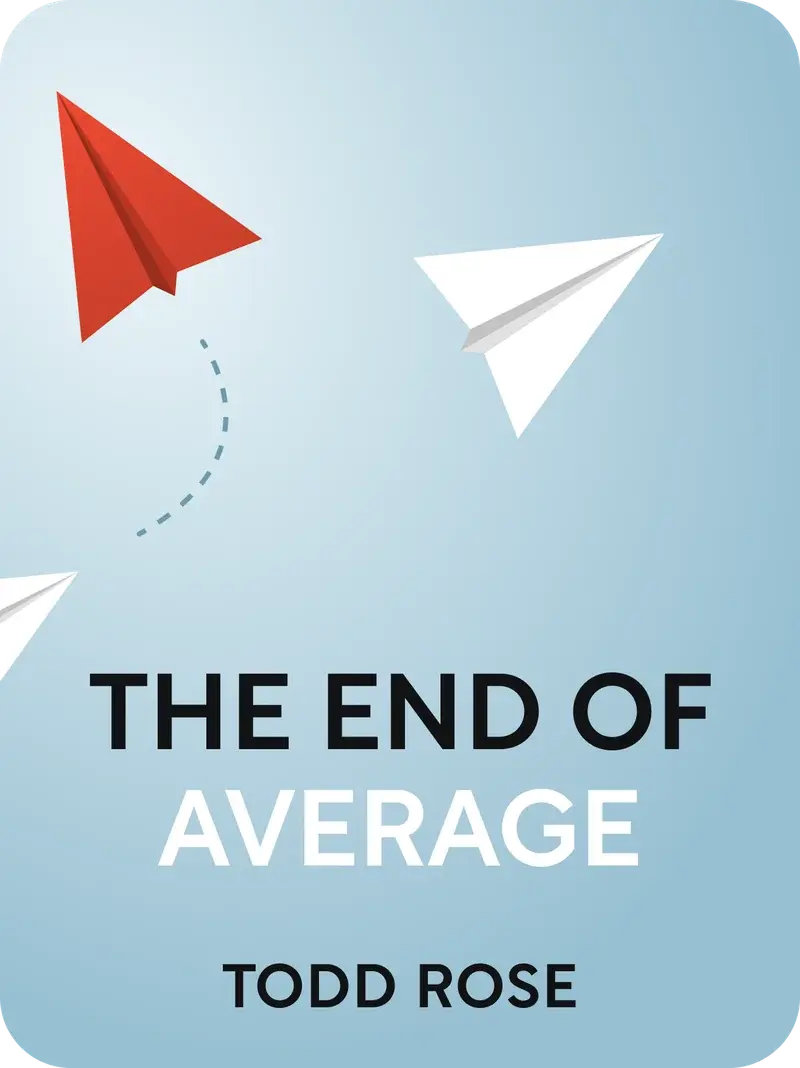
The End Of Average explains the fundamental flaws with our culture of averages, in which we design everything for the average person, when that person doesn’t exist, and shows how we can embrace our individuality and use it to succeed in a world that wants everyone to be the same.
The End Of Average explains the fundamental flaws with our culture of averages, in which we design everything for the average person, when that person doesn’t exist, and shows how we can embrace our individuality and use it to succeed in a world that wants everyone to be the same.
If I asked you to describe Brad Pitt’s appearance in one word, how would you respond? It’s impossible, right? Not just for Brad Pitt, but for anyone. I mean, how many anatomic features can you possibly highlight with one word? Tall just describes height, big usually refers to weight, blonde to hair color, and handsome, well, that couldn’t be more subjective, could it?
When we describe human looks, we always fall back on describing a whole set of individual features, because there’s no single word to squeeze the human anatomy into.
That alone is a good indicator of how much we can learn from computing average human body features – not much. All of these characteristics are completely unrelated to one another, which is the reason knowing someone’s height doesn’t tell you anything about their weight and vice versa.
Yet, many companies have tried (and failed) to design products for “the average human,” for example the US Air Force. In 1950, they measured 140 different dimensions of the bodies of over 4,000 pilots and used the average values to re-design their jet cockpits.
The result? Not a single pilot fit into the standard cockpit. Even if you’d taken just the averages of 3 dimensions, only 3.5% of all pilots would’ve fit the average on all of them. Taking 140 made sure that absolutely no one would fit in.
So if you’ve ever thought “how can I get this to fit the average” about something, I suggest you toss that question out of your repertoire now.
There’s a phenomenon called the Flynn effect, which describes that on average, IQ scores have risen by 3 points per decade. What does that tell you? Nothing, except that we’ve been getting better at filling out IQ tests. The upwards trend is the interesting part, not the average of the increase. As it turns out, averages aren’t just useless when comparing human anatomy, but also when looking at the human mind. For example, in the 1980s, education researcher Benjamin Bloom developed a learning taxonomy that separated the speed of learning and knowledge retention. Just because you can remember things well does not mean you learn faster (or vice versa). How you learn and master new skills is completely unrelated to your character traits, which makes all stereotypes irrelevant, like “nerds suck at sports” or “footballers are meatheads.” But if there is no one right or…
Continue reading in the MinuteRead app
Get the complete 5-minute summary of The End Of Average
Get the complete summary in the appGood luck with building something for the “average human body,” because such a thing doesn’t exist.
Who you are is totally unrelated to how you learn, which means there is absolutely no average career path you can follow.
Companies and people must learn to embrace human individualism, because our behavior is fluid, not fixed.
"The End Of Average" is a strong fit if you want practical ideas around culture, productivity, psychology, especially themes like good luck with building something for the “average human body,” because such a thing doesn’t exist; who you are is totally unrelated to how you learn, which means there is absolutely no average career path you can follow. The MinuteRead summary distills these concepts into a focused read, whether you're deciding whether to buy the book or applying its lessons at work.
Todd Rose is the co-founder and CEO of Populace, a think tank committed to ensuring that all people have the opportunity to pursue fulfilling lives in a thriving society. Prior to Populace, he was a faculty member at Harvard University where he founded the Laboratory for the Science of Individuality and directed the Mind, Brain, and Education program. He lives in Burlington, Massachusetts. For more information visit www.toddrose.com
View all summaries by Todd RoseContinue Reading
Access the complete 5-minute summary and thousands more nonfiction books in the MinuteRead app.

Continue reading the complete summary in the MinuteRead app.