MinuteRead
30 min
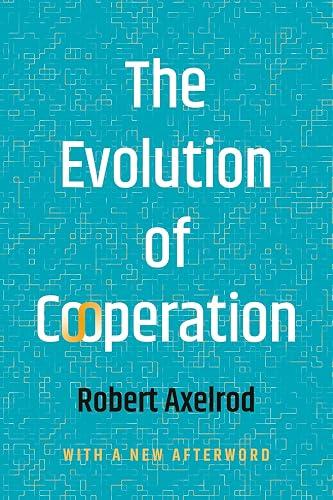
Book summary
by Robert Axelrod
Premium summary · Opens in the app · 30 min read
Imagine two people facing a choice. Each can either help the other or look out only for themselves. If both help, both benefit. If one helps while the other takes advantage, the helper loses and the exploiter wins big. If neither helps, both lose. This is the Prisoner's Dilemma, and it captures a fundamental tension in human life.
**Author:** Robert Axelrod
**Estimated Reading Time:** 45 minutes
**What You'll Learn:**
- Why cooperation emerges even among self-interested individuals - The surprising power of a simple strategy called TIT FOR TAT - How the "shadow of the future" shapes human behavior - Why small clusters of cooperators can transform entire systems - Practical ways to build cooperation in your own life and work
**Who This Book Is For:**
Anyone who has ever wondered why people help each other, how trust develops, or what makes relationships last. This book is for leaders, negotiators, parents, partners, and citizens who want to understand the hidden logic behind human cooperation.
Imagine two people facing a choice. Each can either help the other or look out only for themselves. If both help, both benefit. If one helps while the other takes advantage, the helper loses and the exploiter wins big. If neither helps, both lose. This is the Prisoner's Dilemma, and it captures a fundamental tension in human life. The problem seems intractable. Logic suggests that rational self-interest should lead people to defect, to protect themselves, to grab what they can before someone else does. Yet cooperation is everywhere. Neighbors water each other's plants. Nations sign treaties. Strangers return lost wallets. Businesses form long-term partnerships. How does this happen? Robert Axelrod set out to answer this question using an unusual method. He organized a computer tournament. He invited game theorists, economists, psychologists, and mathematicians from around the world to submit strategies for playing the Prisoner's Dilemma repeatedly against other strategies. The results surprised everyone. The winning strategy was not complicated. It was not clever in the way people expected. It was a simple rule called TIT FOR TAT: cooperate on the first move, then do whatever the other player did on the previous move. This strategy, submitted by psychologist Anatol Rapoport, beat out dozens of far more sophisticated approaches. But the tournament was only the beginning. Axelrod then ran evolutionary simulations, letting strategies compete and reproduce based on their success. Again, TIT FOR TAT rose to dominance. The implications were profound. Cooperation does not require altruism, central authority, or even trust. It can emerge from the simple logic of reciprocity. This book explains why. It shows how the shadow of the future creates incentives for cooperation. It demonstrates how small clusters of cooperators can invade populations of defectors. It reveals why nice strategies prosper but must be willing to retaliate. And it offers practical guidance for fostering cooperation in everything from personal relationships to international diplomacy. The ideas in this book have influenced fields as diverse as biology, economics, political science, and computer science. They help explain why bacteria cooperate, why birds share territories, why…
Continue reading in the MinuteRead app
Get the complete 30-minute summary of The Evolution of Cooperation
Get the complete summary in the appCooperation can emerge among self-interested individuals through reciprocity.
The shadow of the future is the key determinant of cooperation.
TIT FOR TAT is a simple and powerful strategy: cooperate first, then do what the other did.
Successful strategies are nice, provocable, forgiving, and clear.
A small cluster of cooperators can transform a world of defectors.
Cooperation can evolve without conscious design or central authority.
"The Evolution of Cooperation" is a strong fit if you want practical ideas around economics, science, psychology, especially themes like cooperation can emerge among self-interested individuals through reciprocity; the shadow of the future is the key determinant of cooperation. The MinuteRead summary distills these concepts into a focused read, whether you're deciding whether to buy the book or applying its lessons at work.
Motivated to help readers with the issue in terms of "cooperation in organisms, whether bacteria or primates", Robert Axelrod wrote “The Evolution of Cooperation” as a practical guide drawn from years of experience and research. In “The Evolution of Cooperation”, Robert Axelrod focuses on the problem is that while an individual can benefit from mutual cooperation. Through “The Evolution of Cooperation”, Robert Axelrod distills the core ideas on economics into lessons readers can absorb in a sing…
Continue Reading
Access the complete 30-minute summary and thousands more nonfiction books in the MinuteRead app.

Continue reading the complete summary in the MinuteRead app.