MinuteRead
30 min
Book summary
by Matt Ridley
Premium summary · Opens in the app · 5 min read
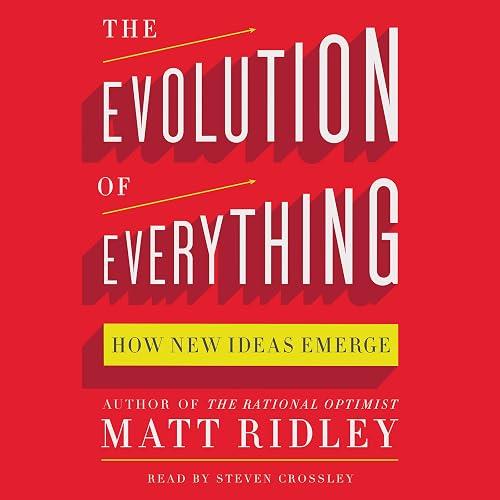
The Evolution Of Everything compares creationist to evolutionist thinking, showing how the process of evolution we know from biology underlies and permeates the entire world, including society, morality, religion, culture, economics, money, innovation and even the internet.
The Evolution Of Everything compares creationist to evolutionist thinking, showing how the process of evolution we know from biology underlies and permeates the entire world, including society, morality, religion, culture, economics, money, innovation and even the internet.
Before we get started, we’d do well to define what evolutionist and creationist even means.
Evolution in its original sense meant “unfolding” and therefore was used to describe how things would gradually change when there was no specific plan. You’d just let things take their course and see what happens. Creation, on the other hand, always suggests an active element of planning and designing – something is calculated and then executed.
Throughout history, creationist thinking has come to shape much of our worldview, especially in the Western world. Ancient Egyptians devoted their lives to gods like Ra, Seth and Anubis, so did the Greeks. Later the Catholic and Protestant church would reduce their religion to just one God, but their destiny still wasn’t theirs to decide. Friedrich Nietzsche said societies depended on strong leaders to flourish and Karl Marx suggested that only a planned economy could thrive.
All of these approaches argue that we need someone at the top to organize us, in order for progress to happen. Matt Ridley not only argues that this is false, but that the opposing view of evolutionism goes back to long before Darwin ever investigated animals on the Galápagos Islands.
In fact, over 400 years BC, two Greek philosophers, Leucippus and Democritus (inspiration to the famous Epicurus) already theorized that the world was made up of atoms – small, indivisible parts – which changed and transformed at random, and were therefore not part of any grand scheme.
What started in ancient Greece as a theory to make sense of the world, turned into a never-ending series of questions, such as “If God designed both humans and the earth, who designed God?” To add oil to the fire, Darwin came up with his theory of evolution, which says that multi-cellular organisms have developed from single-cell organisms, to increase their chances of survival, and that all sub-sequent changes are also based on a “survival of the fittest” process of natural selection. By the late 1970s, Richard Dawkins even suggested that genes themselves are at the core of this process, simply using animal and human bodies as vessels to ensure their survival (which is backed by the fact that many of our genes serve no useful purpose – they seem to be just tagging along). Regarding the history of biology, evolutionist thinking has been widely accepted as the norm in the Western world, but is still a very controversial topic around the globe. What’s much more interesting, and much…
Continue reading in the MinuteRead app
Get the complete 5-minute summary of The Evolution Of Everything
Get the complete summary in the appIn the battle of evolutionist vs. creationist, creationism dominates most of the Western world.
In culture, economics and technology, progress is based on evolution.
The concept of money changed from evolutionist to creationist, and the same could happen to the internet.
"The Evolution Of Everything" is a strong fit if you want practical ideas around culture, entrepreneurship, history, especially themes like in the battle of evolutionist vs. creationist, creationism dominates most of the western world; in culture, economics and technology, progress is based on evolution. The MinuteRead summary distills these concepts into a focused read, whether you're deciding whether to buy the book or applying its lessons at work.
Matt Ridley's books have been shortlisted for six literary awards, including the Los Angeles Times Book Prize (for Genome: The Autobiography of a Species in 23 Chapters). His most recent book, The Agile Gene: How Nature Turns on Nurture, won the award for the best science book published in 2003 from the National Academies of Science. He has been a scientist, a journalist, and a national newspaper columnist, and is the chairman of the International Centre for Life, in Newcastle, England. Matt Rid…
View all summaries by Matt RidleyContinue Reading
Access the complete 5-minute summary and thousands more nonfiction books in the MinuteRead app.

Continue reading the complete summary in the MinuteRead app.