MinuteRead
30 min
Book summary
Premium summary · Opens in the app · 5 min read
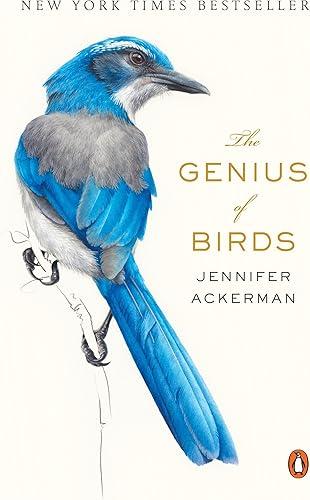
The Genius Of Birds shines a new light on a genuinely underrated kind of vertebrate by explaining birds’ capacities to be social, intelligently solve challenges, learn languages, be artistic and navigate the planet.
The Genius Of Birds shines a new light on a genuinely underrated kind of vertebrate by explaining birds’ capacities to be social, intelligently solve challenges, learn languages, be artistic and navigate the planet.
When I ask you to name a smart animal, chances are you’ll mention one of these three: a chimp, a dolphin, or an elephant. These are the classics. You probably wouldn’t come up with a bird. Yet, just by looking at birds’ brain structure, it can be seen that they must be quite smart.
A human brain makes up about 2% of our body’s mass, 1.3 kg on average (roughly 3 lbs). The brains of chimps and dolphins are similar in terms of weight, an elephant’s brain comes in at roughly 5 kg. Does that mean heavier brain = smarter brain?
Not exactly. What’s more important is the relative weight of the brain when compared to the rest of the body. For example, since an elephant routinely weighs over two tons, its brain accounts for less than 1% of its body mass.
The brain of a New Caledonian crow weighs 7.5 grams on average, with a total body weight of roughly 200 g (again on average). That’s 3.75%!
Throughout evolution, birds have constantly optimized their bodies to accommodate bigger brains, for example by reducing their ovaries from two to just one, reducing liver size and abandoning bladders altogether.
Their relatively large brain size is how they manage to remember thousands of locations where they stored food for months at a time. It allows for a lot of neurogenesis – the creation of new neurons – so they can store each location in a new set of neurons.
As in so many aspects of life, it’s not all about the size of things 😉
You probably know that chimps can use tools in clever ways, like inserting sticks into holes in trees to pull out delicious ants. What you probably didn’t know is that birds are even better at this – only humans surpass them when it comes to employing tools. For example, some owls spread dung around their nests to attract dung beetles to eat, while others scratch their backs with sticks. But especially smart species, like the New Caledonian crow mentioned above, can even make their own tools. These birds can trim branches off of long sticks and even create hook-shaped tools to catch larvae – not even chimps can build these. What completely blew me away however, was this video of a bird solving a complex 8-part-challenge in the right order. Agent 007, as this specimen is called, has to complete a set of tasks in the exact right order to get his food. By…
Continue reading in the MinuteRead app
Get the complete 5-minute summary of The Genius Of Birds
Get the complete summary in the appHow smart you are isn’t determined by how big your brain is. Not entirely, anyways.
Only humans are better at using tools than birds, chimps don’t stand a chance.
Good birds copy, great birds steal – some birds have a great sense of art.
"The Genius Of Birds" is a strong fit if you want practical ideas around psychology, science, especially themes like how smart you are isn’t determined by how big your brain is. not entirely, anyways; only humans are better at using tools than birds, chimps don’t stand a chance. The MinuteRead summary distills these concepts into a focused read, whether you're deciding whether to buy the book or applying its lessons at work.
Motivated to help readers with the Genius Of Birds shines a new light on a genuinely underrated kind of vertebrate by explaining birds’, Jennifer Ackerman wrote “The Genius Of Birds” to package those ideas for a fast, focused read. In “The Genius Of Birds”, Jennifer Ackerman focuses on the Genius Of Birds shines a new light on a genuinely underrated kind of vertebrate by explaining birds’. Through “The Genius Of Birds”, Jennifer Ackerman distills the core ideas on psychology into lessons readers…
View all summaries by Jennifer AckermanContinue Reading
Access the complete 5-minute summary and thousands more nonfiction books in the MinuteRead app.

Continue reading the complete summary in the MinuteRead app.