MinuteRead
30 min
Book summary
by Kibeom Lee
Premium summary · Opens in the app · 30 min read
Every day, you make decisions about whom to trust. You decide whether to lend money to a friend, whether to believe a coworker's promise, whether to confide in a new acquaintance. Most of the time, you make these judgments quickly and intuitively, drawing on subtle cues and past experiences. Sometimes you get it right. Sometimes you don't.
**Author:** Kibeom Lee
**Estimated Reading Time:** 45 minutes
**What You'll Learn:** Why some people consistently choose exploitation over cooperation, how a single personality dimension explains a remarkable range of human behavior, and how to recognize and respond to those who lack this crucial trait.
**Who This Book Is For:** Anyone who has ever been deceived by a charming colleague, wondered why some people seem immune to guilt, or wanted a clearer framework for understanding the ethical differences between people.
Every day, you make decisions about whom to trust. You decide whether to lend money to a friend, whether to believe a coworker's promise, whether to confide in a new acquaintance. Most of the time, you make these judgments quickly and intuitively, drawing on subtle cues and past experiences. Sometimes you get it right. Sometimes you don't. The consequences of getting it wrong can be devastating. A business partner who embezzles funds. A romantic partner who lies without remorse. A politician who promises reform while quietly enriching themselves. These betrayals share a common thread, and for decades, personality psychology lacked a precise way to describe it. The Big Five model of personality dominated the field for much of the twentieth century. It identified five major dimensions: Openness to Experience, Conscientiousness, Extraversion, Agreeableness, and Neuroticism. This framework proved enormously useful for understanding individual differences in behavior, emotion, and cognition. But something was missing. Consider two people who both score high on Agreeableness. One is genuinely kind and fair-minded. The other is pleasant on the surface but manipulative underneath, using charm as a tool for exploitation. The Big Five couldn't distinguish between them. The model lacked a dimension that captured the difference between sincere cooperation and strategic flattery, between genuine humility and calculated modesty. Around the year 2000, researchers began to identify this missing dimension. They called it Honesty-Humility, or simply H. The discovery emerged from cross-cultural studies of personality structure. When researchers analyzed personality descriptors from many different languages, they consistently found a sixth factor that the Big Five had overlooked. This factor captured individual differences in sincerity, fairness, greed avoidance, and modesty. The H factor matters because it predicts behavior that other personality dimensions cannot. It predicts who will cheat when they won't get caught. It predicts who will exploit others when the opportunity arises. It predicts who will seek power for its own sake rather than for what it can accomplish. In short, it predicts the difference between people who cooperate because they genuinely value fairness and people who cooperate only when it serves their interests. Kibeom Lee, a psychology professor at the University of Calgary, has spent his career studying this dimension. His work on the HEXACO model, which…
Continue reading in the MinuteRead app
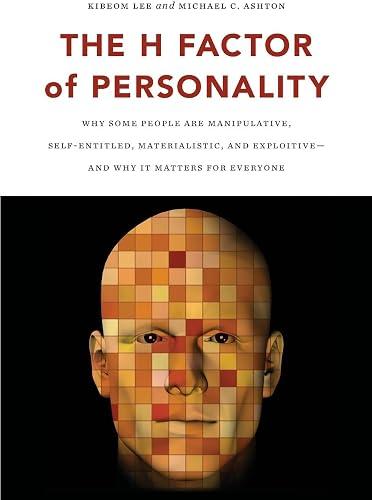
Get the complete 30-minute summary of The H Factor of Personality
Get the complete summary in the appThe H factor is a fundamental dimension of personality that captures the tendency to be fair and genuine versus exploita
The HEXACO model adds Honesty-Humility to the Big Five, creating a six-dimensional framework for understanding personali
High-H people cooperate even when they could exploit you. Low-H people cooperate only when it serves their interests.
Low H combines with other personality traits to create distinct profiles, from cold psychopaths to charming fraudsters.
Accurately judging H requires observing behavior across diverse situations over time. First impressions are unreliable.
Valid signs of low H include beating the system, instrumental ingratiation, conspicuous consumption, and an above-the-la
"The H Factor of Personality" is a strong fit if you want practical ideas around psychology, self help, science, especially themes like the h factor is a fundamental dimension of personality that captures the tendency to be fair and genuine versus exploita; the hexaco model adds honesty-humility to the big five, creating a six-dimensional framework for understanding personali. The MinuteRead summary distills these concepts into a focused read, whether you're deciding whether to buy the book or applying its lessons at work.
Motivated to help readers with we call this personality dimension the H factor, Kibeom Lee wrote “The H Factor of Personality” to package those ideas for a fast, focused read. Through “The H Factor of Personality”, Kibeom Lee distills the core ideas on psychology into lessons readers can absorb in a single short sitting. Readers turn to this work when they want Kibeom Lee's perspective on the subject without working through the entire original volume. The book is structured so each chapter highl…
Continue Reading
Access the complete 30-minute summary and thousands more nonfiction books in the MinuteRead app.

Continue reading the complete summary in the MinuteRead app.