MinuteRead
30 min
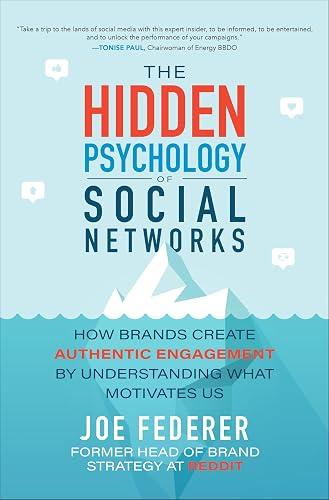
Book summary
by Joe Federer
Premium summary · Opens in the app · 30 min read
Every day, billions of people open social media apps and participate in the largest experiment in human communication ever conducted. We share photos, argue about politics, discover new products, build communities, and craft versions of ourselves for public consumption. Yet for all this activity, remarkably few people understand why social networks work the way they do.
**Author:** Joe Federer
**Estimated Reading Time:** 45 minutes
**What You'll Learn:**
- Why ideas spread through social networks the same way genes spread through populations - How different platforms satisfy different psychological needs - Why the architecture of a social network shapes everything that happens within it - How to create content that people genuinely want to share - Why authenticity matters more than cleverness - How to build a social media strategy that lasts beyond the next algorithm change
**Who This Book Is For:**
This book is for marketers, brand strategists, content creators, and anyone who wants to understand why people behave the way they do online. It is for the social media manager who feels trapped in the endless cycle of chasing trends. It is for the business owner who wonders why their content works on one platform but falls flat on another. It is for the curious observer who wants to understand the hidden forces shaping our digital lives.
Every day, billions of people open social media apps and participate in the largest experiment in human communication ever conducted. We share photos, argue about politics, discover new products, build communities, and craft versions of ourselves for public consumption. Yet for all this activity, remarkably few people understand why social networks work the way they do. Joe Federer wrote this book to answer a question that has puzzled marketers and observers since the first social platforms emerged: why do some ideas spread like wildfire while others disappear without a trace? Why does a particular meme capture the collective imagination while a carefully crafted brand campaign generates nothing but silence? The answer, Federer argues, lies not in the technology but in the psychology. Social networks are not neutral conduits for information. They are psychological environments, each with its own rules, rewards, and social dynamics. To understand social media, you must understand the minds of the people using it. The problem is that most brands approach social media as if it were simply another broadcast channel. They create content designed to interrupt, persuade, and convert. They measure success in clicks and impressions. They treat platforms as interchangeable distribution mechanisms. This approach fails because it ignores the fundamental truth that people do not use social media to be marketed to. They use it to connect, to express themselves, to explore, and to belong. Federer's approach is different. Drawing on evolutionary biology, Freudian psychology, and years of hands-on experience in digital marketing, he offers a framework for understanding social networks as psychological spaces. He argues that the structure of a platform determines the psychology of its users, and that the psychology of its users determines what kind of content will succeed. The…
Continue reading in the MinuteRead app
Get the complete 30-minute summary of The Hidden Psychology of Social Networks
Get the complete summary in the appIdeas spread like genes: they replicate, mutate, and compete for survival. Create content with the characteristics of su
The format that carries an idea is as important as the idea itself. Choose meme machines that are easy to use and resist
Different platforms satisfy different psychological needs. Facebook is an ego network, Instagram is a superego network,
Tailor content to the psychological environment of each platform. What works on one platform will not necessarily work o
Users share content that helps them express their identity. Create badgeworthy content that gives users something to ass
Authenticity cannot be faked. Align actions with words, engage in genuine conversation, and admit mistakes.
"The Hidden Psychology of Social Networks" is a strong fit if you want practical ideas around psychology, business, technology, especially themes like ideas spread like genes: they replicate, mutate, and compete for survival. create content with the characteristics of su; the format that carries an idea is as important as the idea itself. choose meme machines that are easy to use and resist. The MinuteRead summary distills these concepts into a focused read, whether you're deciding whether to buy the book or applying its lessons at work.
Motivated to help readers with meme in the traditional, Joe Federer wrote “The Hidden Psychology of Social Networks” to package those ideas for a fast, focused read. In “The Hidden Psychology of Social Networks”, Joe Federer focuses on meme in the traditional. Through “The Hidden Psychology of Social Networks”, Joe Federer distills the core ideas on psychology into lessons readers can absorb in a single short sitting. Readers turn to this work when they want Joe Federer's perspective on the subj…
Continue Reading
Access the complete 30-minute summary and thousands more nonfiction books in the MinuteRead app.

Continue reading the complete summary in the MinuteRead app.