MinuteRead
30 min
Book summary
Premium summary · Opens in the app · 30 min read
Every day you make hundreds of decisions. What to eat. What to wear. What to buy. What to ignore. Most of these decisions feel deliberate. You weigh options. You consider preferences. You choose.
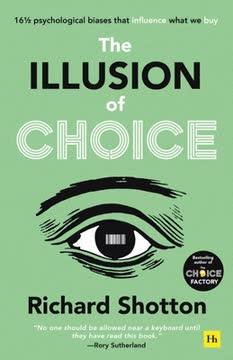
**Author:** Richard Shotton
**Estimated Reading Time:** 45 minutes
**What You'll Learn:**
- Why the choices you think you make are shaped by invisible forces - How context, color, and packaging override product quality - The specific psychological biases that drive purchasing decisions - How to apply these insights to marketing, business, and everyday life - Why small changes in wording and presentation produce outsized results
**Who This Book Is For:**
This book is for marketers, business owners, and anyone curious about why people buy what they buy. It is also for readers who want to understand the hidden architecture of their own decisions. If you have ever wondered why you chose one product over another despite no meaningful difference, this book will show you the machinery behind that choice.
Every day you make hundreds of decisions. What to eat. What to wear. What to buy. What to ignore. Most of these decisions feel deliberate. You weigh options. You consider preferences. You choose. But what if most of that feeling is an illusion? Richard Shotton's central argument is uncomfortable for anyone who believes they are a rational consumer. The choices you make are not the product of careful deliberation. They are shaped by a set of psychological shortcuts that operate below conscious awareness. These shortcuts evolved to help humans navigate a complex world without exhausting their mental resources. They work well enough most of the time. But they can be exploited. The evidence for this is overwhelming. In one famous experiment from the 1940s, psychologist Louis Cheskin served housewives two products. One was margarine dyed yellow and labeled as butter. The other was actual butter dyed white and labeled as margarine. The women overwhelmingly preferred the "butter." They disparaged the "margarine." Their taste buds were not broken. Their expectations were simply doing the tasting for them. Cheskin called this phenomenon "sensation transference." The color, the label, the packaging, the smell, the context: all of these elements transfer onto the product itself. You do not taste what is in your mouth. You taste what you expect to taste. This insight has profound implications. It means that quality is not enough. It means that the best product does not automatically win. It means that the context surrounding a product, a service, or an idea often matters more than the thing itself. Shotton spent years cataloging these biases. He read the academic literature. He tested the findings in commercial settings. He ran his own experiments. The result is a practical guide to the psychological forces that shape consumer behavior. The book is built around sixteen and a half biases. Some are famous, like the IKEA effect or the peak-end rule. Others are less well…
Continue reading in the MinuteRead app
Get the complete 30-minute summary of The Illusion of Choice
Get the complete summary in the appContext shapes choice more than quality does. Design the context before you improve the product.
Reduce friction before you increase motivation. Small obstacles have outsized effects on behavior.
Time behavior change to fresh starts. The beginning of a week, month, or year weakens old habits.
Add a small amount of visible effort to increase perceived value. Effort creates ownership and pride.
Use concrete language. Concrete words are remembered ten times better than abstract ones.
Rhyme boosts believability. The easier information is to process, the more true it feels.
"The Illusion of Choice" is a strong fit if you want practical ideas around psychology, business, economics, especially themes like context shapes choice more than quality does. design the context before you improve the product; reduce friction before you increase motivation. small obstacles have outsized effects on behavior. The MinuteRead summary distills these concepts into a focused read, whether you're deciding whether to buy the book or applying its lessons at work.
Richard Shotton is a behavioral scientist and marketing expert known for his work in applying psychological principles to advertising and consumer behavior. He has authored multiple books on the subject, including "The Choice Factory" and "The Illusion of Choice." Shotton's writing style is praised for its clarity and accessibility, making complex scientific concepts understandable to a general audience. He draws on a wide range of psychological studies and experiments to support his ideas, thou…
View all summaries by Richard ShottonContinue Reading
Access the complete 30-minute summary and thousands more nonfiction books in the MinuteRead app.

Continue reading the complete summary in the MinuteRead app.