MinuteRead
30 min
Book summary
Premium summary · Opens in the app · 30 min read
In the summer of 1972, a young woman named Linda Cooper was struck by lightning. She survived, though the experience left her shaken and grateful to be alive. What makes her story remarkable is not that she was struck once. It is that she was struck again, years later, in an entirely different location. And then, astonishingly, she was struck a third time.
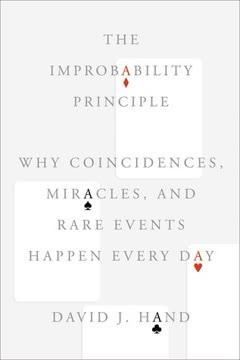
**Author:** David J. Hand
**Estimated Reading Time:** 45 minutes
**What You'll Learn:**
- Why extremely improbable events happen constantly - The five fundamental laws that explain coincidences and rare occurrences - How our minds deceive us when interpreting chance events - Why someone wins the lottery twice and lightning strikes the same person repeatedly - How to apply these insights to make better decisions in science, business, and daily life
**Who This Book Is For:**
Anyone who has ever wondered about a strange coincidence, marveled at an unlikely event, or questioned whether something "too improbable to be chance" might have a deeper meaning. This book is for the curious mind seeking rational explanations for the seemingly inexplicable.
In the summer of 1972, a young woman named Linda Cooper was struck by lightning. She survived, though the experience left her shaken and grateful to be alive. What makes her story remarkable is not that she was struck once. It is that she was struck again, years later, in an entirely different location. And then, astonishingly, she was struck a third time. When we hear stories like this, our minds race. What are the odds? Surely this cannot be mere chance. There must be some explanation, some cosmic force, some hidden pattern. We search for meaning because the alternative, that such events simply happen, feels deeply unsatisfying. David J. Hand, one of the world's leading statisticians, has spent his career studying probability and the mathematics of uncertainty. In The Improbability Principle, he argues that our intuition about rare events is fundamentally flawed. We are astonished by coincidences because we misunderstand how probability actually works in a world of billions of people and countless daily events. The central claim of the book is both simple and profound: extremely improbable events are commonplace. They happen all the time, all around us, and they should not surprise us. In fact, Hand argues, it would be far more surprising if strange coincidences and seemingly miraculous events did not occur regularly. This matters because our misunderstanding of probability has real consequences. People misinterpret rare events as evidence of supernatural intervention. Investors build financial models that catastrophically fail. Scientists chase false discoveries. Ordinary people make poor decisions because they misjudge the likelihood of events. Hand's approach is different from typical books about probability. He does not drown readers in mathematical formulas or abstract theory. Instead, he builds a framework of five simple laws that, when combined, explain why the improbable happens so frequently. These laws are rooted in fundamental properties of the universe, deep principles of probability, and quirks of human psychology. The Improbability Principle is not just an intellectual exercise. It is a practical tool for understanding…
Continue reading in the MinuteRead app
Get the complete 30-minute summary of The Improbability Principle
Get the complete summary in the appExtremely improbable events are commonplace. They happen all the time, all around us.
Something must happen. The Law of Inevitability says that one of all possible outcomes must occur.
With enough opportunities, any outrageous thing is likely to happen. The Law of Truly Large Numbers explains why rare ev
You can make probabilities as high as you like if you choose after the event. The Law of Selection explains why track re
A slight change in circumstances can have a huge impact on probabilities. The Law of the Probability Lever explains why
Events which are sufficiently similar are regarded as identical. The Law of Near Enough explains why vague predictions a
"The Improbability Principle" is a strong fit if you want practical ideas around science, mathematics, psychology, especially themes like extremely improbable events are commonplace. they happen all the time, all around us; something must happen. the law of inevitability says that one of all possible outcomes must occur. The MinuteRead summary distills these concepts into a focused read, whether you're deciding whether to buy the book or applying its lessons at work.
David J. Hand is a renowned statistician and mathematician with extensive academic and professional experience. He holds positions at Imperial College London and Winton Capital Management, and is a Fellow of the British Academy. Hand has served as President of the Royal Statistical Society and sits on the UK Statistics Authority Board. His research spans various fields, including classification, data mining, and anomaly detection. Hand has published numerous scientific papers and books, with app…
View all summaries by David J. HandContinue Reading
Access the complete 30-minute summary and thousands more nonfiction books in the MinuteRead app.

Continue reading the complete summary in the MinuteRead app.