MinuteRead
30 min
Book summary
by Christopher Chabris
Premium summary · Opens in the app · 30 min read
In the late 1990s, two psychologists at Harvard University created a short film that would become one of the most famous experiments in the history of cognitive science. The film shows two teams of students, one wearing white shirts and one wearing black shirts, passing basketballs back and forth. Viewers are given a simple task: count how many times the players in white pass the ball.
**Author:** Christopher Chabris and Daniel Simons
**Estimated Reading Time:** 45 minutes
**What You'll Learn:** Why you miss obvious things, why your memories are not as reliable as you believe, why confident people are often wrong, and how to recognize the hidden limits of your own mind.
**Who This Book Is For:** Anyone who has ever been certain they saw something that didn't happen, trusted a confident expert who turned out to be wrong, or wondered why smart people make terrible decisions.
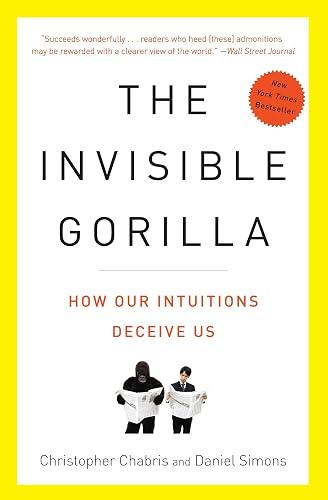
In the late 1990s, two psychologists at Harvard University created a short film that would become one of the most famous experiments in the history of cognitive science. The film shows two teams of students, one wearing white shirts and one wearing black shirts, passing basketballs back and forth. Viewers are given a simple task: count how many times the players in white pass the ball. About halfway through the video, a woman in a full gorilla suit walks directly through the middle of the action, stops in the center of the screen, thumps her chest, and walks off. The gorilla is visible for nine full seconds. When the researchers asked viewers whether they had seen anything unusual, roughly half of them had seen nothing at all. Not a glimpse. Not a flicker. Nothing. This result stunned people. How could anyone miss a gorilla? The answer, as Christopher Chabris and Daniel Simons explain, is not that some people have bad eyesight or poor attention. The answer is that everyone's attention is radically limited in ways we fail to recognize. The gorilla experiment did not reveal a flaw in a few people. It revealed a flaw in how all human minds work. The problem is not that we have limitations. Every system has limitations. The problem is that we walk through life believing we see far more than we actually see, remember far more than we actually remember, and understand far more than we actually understand. These beliefs are not just mistaken. They are dangerous. Consider what happens when a driver talks on a phone. Most people believe they can handle it. They believe their attention can stretch to cover the road and the conversation. But the research shows something different. When you talk on a phone while driving, your brain does not divide attention evenly. It switches rapidly between tasks, and during each switch, something gets lost. Drivers on phones miss traffic signals, react slowly to hazards, and fail to see things directly in front of them. They are not bad drivers. They are normal humans experiencing the limits of attention. The same pattern appears in memory. Most people think of memory as a recording device. Something happens, the…
Continue reading in the MinuteRead app
Get the complete 30-minute summary of The Invisible Gorilla
Get the complete summary in the appAttention is limited. When you focus on one thing, you miss other things.
Multitasking is a myth. You are actually switching rapidly between tasks, and each switch has a cost.
Memory is reconstructive, not a recording. Each time you recall a memory, you may alter it.
Confidence is not competence. The least skilled people are often the most confident.
You understand less than you think. Try to explain something in detail and you will see the gaps.
Humans see patterns everywhere, even in random data. Correlation is not causation.
"The Invisible Gorilla" is a strong fit if you want practical ideas around psychology, science, self help, especially themes like attention is limited. when you focus on one thing, you miss other things; multitasking is a myth. you are actually switching rapidly between tasks, and each switch has a cost. The MinuteRead summary distills these concepts into a focused read, whether you're deciding whether to buy the book or applying its lessons at work.
Motivated to help readers with if we were fully aware of the limits to attention, Christopher Chabris wrote “The Invisible Gorilla” to package those ideas for a fast, focused read. In “The Invisible Gorilla”, Christopher Chabris focuses on if we were fully aware of the limits to attention. Through “The Invisible Gorilla”, Christopher Chabris distills the core ideas on psychology into lessons readers can absorb in a single short sitting. Readers turn to this work when they want Christopher Chabri…
Continue Reading
Access the complete 30-minute summary and thousands more nonfiction books in the MinuteRead app.

Continue reading the complete summary in the MinuteRead app.