MinuteRead
30 min
Book summary
Premium summary · Opens in the app · 30 min read
For decades we have been told a simple story. Vitamin D is good for your bones. You can get it from the sun or from fortified milk. If you take a supplement, a few hundred international units should be plenty. Too much could be dangerous. Wear sunscreen. Stay out of the midday sun. Trust the guidelines.
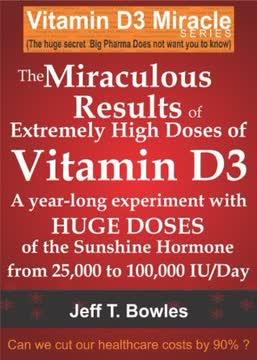
**My Experiment With Huge Doses Of D3 From 25,000 To 50,000 To 100,000 IU A Day Over A 1 Year Period**
**By Jeff T. Bowles**
**Estimated Reading Time:** 45 minutes
**What You'll Learn**
Why vitamin D3 is not actually a vitamin but a powerful hormone that influences nearly every cell in your body. How modern indoor living has created a widespread deficiency that may explain many chronic diseases. What happens when one person decided to take doses far beyond conventional recommendations. How vitamin K2 makes high-dose D3 safe. Why the medical establishment has been slow to embrace this approach. How to think about finding your own optimal dose.
**Who This Book Is For**
This book is for anyone who has struggled with chronic health issues that conventional medicine has failed to resolve. It is for the curious, the skeptical, and the self-experimenters who believe that sometimes the most profound answers are hiding in plain sight. It is for those willing to question established narratives and consider that sunlight, the very thing we have been told to avoid, might hold the key to vibrant health.
For decades we have been told a simple story. Vitamin D is good for your bones. You can get it from the sun or from fortified milk. If you take a supplement, a few hundred international units should be plenty. Too much could be dangerous. Wear sunscreen. Stay out of the midday sun. Trust the guidelines. Jeff T. Bowles began to suspect that this story was not just incomplete but fundamentally wrong. His journey started the way many health transformations do: with a problem that would not go away. Bowles was in his fifties and felt his body deteriorating in ways both large and small. His shoulders ached. His hip clicked when he walked. His toenails had turned yellow and thickened. He was gaining weight. His energy was flagging. He felt, in his own words, like he was falling apart. Doctors offered little help. The standard advice was to accept these changes as a normal part of aging. But Bowles refused to accept that narrative. He began reading scientific literature, diving into studies that had been published decades ago and then largely forgotten. What he found astonished him. Vitamin D3, he discovered, was not really a vitamin at all. It was a hormone, a seco-steroid hormone to be precise, produced in the skin when sunlight strikes it. This hormone does not just help with calcium absorption. It regulates the expression of over one thousand genes. It influences immune function, cell growth, inflammation, mood, metabolism, and tissue repair. It is, in essence, a master switch for human health. And modern humans, Bowles realized, were almost universally deficient…
Continue reading in the MinuteRead app
Get the complete 30-minute summary of The Miraculous Results Of Extremely High Doses Of The Sunshine Hormone Vitamin D3 My Experiment With Huge Doses Of D3 From 25,000 To 50,000 To 100,000 Iu A Day Over A 1 Year Period
Get the complete summary in the appVitamin D3 is a hormone, not a vitamin, and it regulates over 1,000 genes in your body.
Most people in the modern world are severely deficient in D3 due to indoor living and sunscreen use.
Low D3 triggers a hibernation response: weight gain, fatigue, depression, and immune suppression.
Low D3 also causes incomplete repair, leading to chronic pain and degenerative conditions.
High-dose D3 therapy can correct deficiency and produce dramatic health improvements.
Always pair D3 with vitamin K2 to prevent calcium buildup in soft tissues.
"The Miraculous Results Of Extremely High Doses Of The Sunshine Hormone Vitamin D3 My Experiment With Huge Doses Of D3 From 25,000 To 50,000 To 100,000 Iu A Day Over A 1 Year Period" is a strong fit if you want practical ideas around health & fitness, health, science, especially themes like vitamin d3 is a hormone, not a vitamin, and it regulates over 1,000 genes in your body; most people in the modern world are severely deficient in d3 due to indoor living and sunscreen use. The MinuteRead summary distills these concepts into a focused read, whether you're deciding whether to buy the book or applying its lessons at work.
Jeff T. Bowles is a self-experimenter and researcher who conducted a year-long study on high-dose vitamin D3 supplementation. He is not a medical professional but has extensively researched the topic of vitamin D3 and its potential health benefits. Bowles is passionate about sharing his findings and theories regarding the importance of vitamin D3 in human health. He has written about his personal experiences and gathered anecdotal evidence from readers who have tried his high-dose approach. Bowl…
View all summaries by Jeff T. BowlesContinue Reading
Access the complete 30-minute summary and thousands more nonfiction books in the MinuteRead app.

Continue reading the complete summary in the MinuteRead app.