MinuteRead
30 min
Book summary
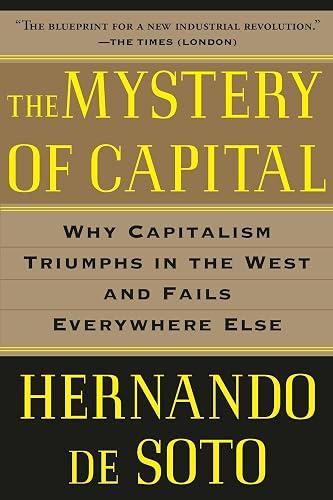
by Hernando de Soto
Premium summary · Opens in the app · 30 min read
Imagine you own a house. You built it with your own hands over many years. You have lived in it, improved it, raised children in it. Your neighbors recognize it as yours. Your community respects your claim. By every practical measure, you own that house.
**Author:** Hernando de Soto
**Estimated Reading Time:** 45 minutes
**What You'll Learn:** Why capitalism succeeds in the West but fails almost everywhere else, how the poor already possess trillions in assets they cannot use, and what it takes to transform dead capital into living wealth.
**Who This Book Is For:** Anyone who wants to understand why poverty persists despite enormous effort and aid, and anyone interested in the hidden architecture that makes modern economies work.
Imagine you own a house. You built it with your own hands over many years. You have lived in it, improved it, raised children in it. Your neighbors recognize it as yours. Your community respects your claim. By every practical measure, you own that house. Now imagine trying to get a loan to start a business using that house as collateral. The bank asks for your title deed. You do not have one. The bank asks for your property registration number. It does not exist. The bank asks for proof that you can legally sell the house. You cannot provide it. Suddenly, your house is not an asset in any meaningful economic sense. It is just a physical structure. It cannot be leveraged, divided, invested, or used to generate capital. It is dead. This is the reality for billions of people around the world. Hernando de Soto and his research team spent years documenting what they call the "extralegal" sector: the vast portion of humanity that lives, works, and owns property outside formal legal systems. Their findings were staggering. In Egypt, 92 percent of urban dwellers hold property without legal title. In Haiti, 68 percent. In Peru, 53 percent. In the Philippines, 57 percent of urban residents live in informal settlements. These are not marginal populations. They are the majority. The most remarkable discovery was not the scale of informality, but its value. De Soto's team calculated that the total value of real estate held but not legally owned by the poor of the Third World and former communist nations is at least $9.3 trillion. To put that number in perspective, it is roughly twice the total circulating U.S. currency at the time of the book's publication. It is more than all foreign direct investment in developing countries combined over decades. It is more than twenty times all foreign aid given to the developing world since 1945. The poor are not poor because they lack assets. They are poor because they lack the legal mechanisms that turn assets into capital. This insight challenges decades of conventional wisdom about development. For years, economists and policymakers assumed that poverty resulted from a lack of assets, a lack of education, a lack of technology, or a lack of…
Continue reading in the MinuteRead app
Get the complete 30-minute summary of The Mystery Of Capital
Get the complete summary in the appThe poor possess at least $9.3 trillion in assets that cannot be used as capital because they lack legal representation.
Capital is not the same as assets. Capital is the potential of assets to generate new value, unlocked through legal repr
Property is about the legal representation of assets, not the assets themselves.
The extralegal sector is vibrant but undercapitalized. The poor have created sophisticated informal arrangements that ca
Formal property systems create capital by providing standardized information about assets that allows them to be valued,
Western nations built their property systems from the bottom up by integrating extralegal arrangements into formal law.
"The Mystery Of Capital" is a strong fit if you want practical ideas around economics, politics, business, especially themes like the poor possess at least $9.3 trillion in assets that cannot be used as capital because they lack legal representation; capital is not the same as assets. capital is the potential of assets to generate new value, unlocked through legal repr. The MinuteRead summary distills these concepts into a focused read, whether you're deciding whether to buy the book or applying its lessons at work.
Motivated to help readers with "By our calculations, Hernando de Soto wrote “The Mystery Of Capital” to package those ideas for a fast, focused read. In “The Mystery Of Capital”, Hernando de Soto focuses on "By our calculations. Through “The Mystery Of Capital”, Hernando de Soto distills the core ideas on economics into lessons readers can absorb in a single short sitting. Readers turn to this work when they want Hernando de Soto's perspective on the subject without working through the entire or…
Continue Reading
Access the complete 30-minute summary and thousands more nonfiction books in the MinuteRead app.

Continue reading the complete summary in the MinuteRead app.