MinuteRead
30 min
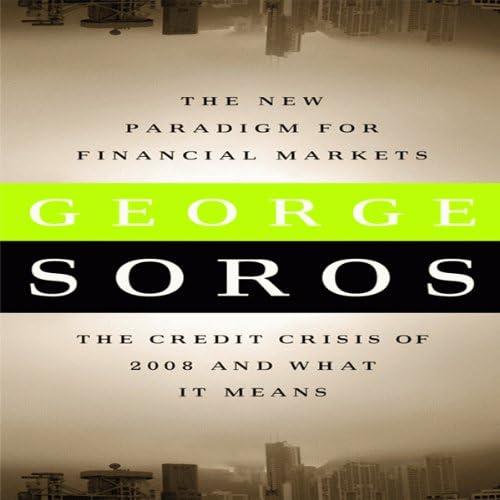
Book summary
by George Soros
Premium summary · Opens in the app · 30 min read
In the autumn of 2008, the global financial system came closer to collapse than at any point since the 1930s. Major investment banks vanished overnight. Credit markets froze. Governments scrambled to prevent a cascading series of failures that threatened to plunge the world into a depression. The crisis was not a random accident. It was the culmination of decades of misguided beliefs, systematic policy errors, and a fundamental misunderstanding of how financial markets actually operate.
**Author:** George Soros
**Estimated Reading Time:** 45 minutes
**What You'll Learn:**
- Why financial markets are inherently unstable, not self-correcting - How a two-way feedback loop between perception and reality drives booms and busts - What a "super-bubble" is and why the 2008 crisis was not an isolated event - How flawed economic theory contributed to the greatest financial collapse since the Great Depression - Why the global balance of economic power is shifting and what it means for the future - How to think about markets, policy, and risk in a world where uncertainty is fundamental
**Who This Book Is For:**
This book is for anyone who wants to understand why financial crises happen, why experts so often get things wrong, and how a deeper understanding of human behavior can illuminate the hidden forces shaping economies. It is for investors, policymakers, students of economics, and curious readers who sense that the standard explanations of how markets work are incomplete. If you have ever wondered why bubbles form despite widespread awareness of past bubbles, or why regulators failed to prevent the 2008 collapse, this book offers a compelling answer.
In the autumn of 2008, the global financial system came closer to collapse than at any point since the 1930s. Major investment banks vanished overnight. Credit markets froze. Governments scrambled to prevent a cascading series of failures that threatened to plunge the world into a depression. The crisis was not a random accident. It was the culmination of decades of misguided beliefs, systematic policy errors, and a fundamental misunderstanding of how financial markets actually operate. George Soros wrote this book in the midst of that unfolding disaster. He had spent decades developing a philosophical framework for understanding the relationship between human thinking and reality, a framework he calls reflexivity. This framework, he argues, explains why markets do not tend toward equilibrium as mainstream economics teaches. Instead, markets are prone to boom-bust sequences, bubbles, and sudden reversals. The 2008 crisis was not an anomaly. It was the predictable result of a long-building super-bubble, a massive expansion of credit and a blind faith in the self-correcting nature of markets. The problem Soros identifies is not simply that financial institutions took excessive risks. The deeper problem is intellectual. The prevailing economic theory, with its assumption of rational actors and self-correcting markets, encouraged regulators to step back. It gave intellectual cover to the deregulation that allowed dangerous financial innovations to flourish. It created a false sense of security among policymakers, bankers, and investors. When the crisis hit, the theoretical framework that had guided policy for decades offered little guidance. Soros's approach is different. He does not start with abstract models of perfect competition or rational…
Continue reading in the MinuteRead app
Get the complete 30-minute summary of The New Paradigm for Financial Markets
Get the complete summary in the appReflexivity is the two-way connection between thinking and reality. It is the key to understanding why markets are unsta
Markets do not tend toward equilibrium. They are prone to boom-bust cycles.
The 2008 crisis was the culmination of a super-bubble that had been building since the 1980s.
Market fundamentalism, the belief that markets are self-correcting, is dangerous and wrong.
Our understanding of social reality is inherently imperfect. Precise prediction is impossible.
Uncertainty is a permanent feature of social life, not a temporary condition.
"The New Paradigm for Financial Markets" is a strong fit if you want practical ideas around economics, finance, business, especially themes like reflexivity is the two-way connection between thinking and reality. it is the key to understanding why markets are unsta; markets do not tend toward equilibrium. they are prone to boom-bust cycles. The MinuteRead summary distills these concepts into a focused read, whether you're deciding whether to buy the book or applying its lessons at work.
Motivated to help readers with there is a two-way connection between thinking and reality which, George Soros wrote “The New Paradigm for Financial Markets” to package those ideas for a fast, focused read. In “The New Paradigm for Financial Markets”, George Soros focuses on there is a two-way connection between thinking and reality which. Through “The New Paradigm for Financial Markets”, George Soros distills the core ideas on economics into lessons readers can absorb in a single short sitting. …
View all summaries by George SorosContinue Reading
Access the complete 30-minute summary and thousands more nonfiction books in the MinuteRead app.

Continue reading the complete summary in the MinuteRead app.