MinuteRead
30 min
Book summary
Premium summary · Opens in the app · 30 min read
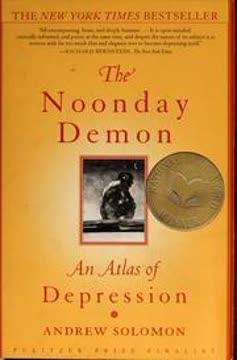
There is a moment in the life of almost every person when the world goes dark. For some, the darkness passes like a summer storm, leaving the air cleaner and the light sharper. For others, the darkness settles in and stays. It becomes not a moment but a condition, not a mood but a way of being. This book is about that second kind of darkness.
**Author:** Andrew Solomon
**Estimated Reading Time:** 45 minutes
**What You'll Learn:** The true nature of depression as experienced from the inside, the science behind why it happens, the range of treatments that work, and how individuals and societies can respond with wisdom and compassion.
**Who This Book Is For:** Anyone who has experienced depression, loves someone who has, treats those who suffer, or wants to understand one of the most pervasive and misunderstood conditions of modern life.
There is a moment in the life of almost every person when the world goes dark. For some, the darkness passes like a summer storm, leaving the air cleaner and the light sharper. For others, the darkness settles in and stays. It becomes not a moment but a condition, not a mood but a way of being. This book is about that second kind of darkness. Andrew Solomon wrote The Noonday Demon from a position of hard-won authority. He has lived through three major depressive episodes, each one severe enough to reshape his understanding of what a human being can endure. He has also spent years interviewing hundreds of other people who share this condition, from the desperately poor to the fabulously wealthy, from remote villages in Greenland to bustling cities in Cambodia, from children to the very old. The result is a book that is simultaneously a memoir, a work of investigative journalism, a scientific survey, and a philosophical meditation. The title comes from a phrase in the Psalms, referring to "the destruction that wasteth at noonday." In the ancient world, the noonday demon was understood as a spiritual force that struck people down in the middle of the day, when the sun was at its highest and life should have felt most vibrant. The phrase captures something essential about depression: it arrives when it should not, in the midst of ordinary life, and it devastates without warning or apparent cause. Depression is one of the most common afflictions in the world. The World Health Organization has identified it as the leading cause of disability globally, affecting more than 280 million people. It claims more years of productive life than war, cancer, and AIDS combined. Yet despite its prevalence, depression remains profoundly misunderstood. People who have never experienced it often imagine it as a kind of exaggerated sadness, something that can be cured by a good night's sleep, a brisk walk, or a change in attitude. Those who have experienced it know that it is something else entirely. Solomon makes a crucial distinction early in the book. Grief is not depression. Sadness is not depression. These are healthy, proportionate responses to loss and difficulty. Depression is different. It is what happens when…
Continue reading in the MinuteRead app
Get the complete 30-minute summary of The Noonday Demon
Get the complete summary in the appDepression is an illness, not a weakness or a character flaw.
Depression is not sadness. It is a loss of the capacity to feel.
Depression arises from the interaction of biological, psychological, and social factors.
Treatment works, but finding the right treatment requires patience and persistence.
Isolation compounds depression. Connection is the beginning of recovery.
Suicidal thoughts are a symptom of severe depression and should always be taken seriously.
"The Noonday Demon" is a strong fit if you want practical ideas around health & fitness, psychology, mental health, especially themes like depression is an illness, not a weakness or a character flaw; depression is not sadness. it is a loss of the capacity to feel. The MinuteRead summary distills these concepts into a focused read, whether you're deciding whether to buy the book or applying its lessons at work.
Andrew Solomon is a renowned writer and lecturer focusing on politics, culture, and mental health. He has contributed to prestigious publications like The New York Times and The New Yorker, covering diverse topics from depression to international politics. Solomon's work on mental health earned him the Humanitarian Award from the Society of Biological Psychiatry. He holds a lecturer position at Cornell Medical School and divides his time between New York and London. Solomon's writing style combi…
View all summaries by Andrew SolomonContinue Reading
Access the complete 30-minute summary and thousands more nonfiction books in the MinuteRead app.

Continue reading the complete summary in the MinuteRead app.