MinuteRead
30 min
Book summary
Premium summary · Opens in the app · 30 min read
You misplaced your keys again. You forgot the one item you went to the grocery store to buy. You spent twenty minutes deciding what to wear, answered three emails while eating lunch, and now you cannot remember what any of them said. By evening, you are exhausted but cannot point to anything meaningful you accomplished. The day evaporated into a fog of small decisions and interruptions.
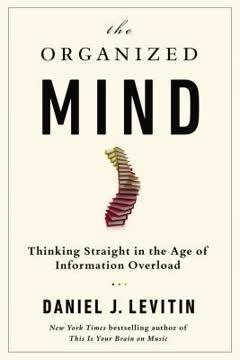
**Author:** Daniel J. Levitin **Estimated Reading Time:** 45 minutes
**What You'll Learn:** Why your brain feels overwhelmed in the modern world, how attention and memory actually work, and practical systems for organizing your home, work, time, and decisions so you can think clearly and stop feeling exhausted.
**Who This Book Is For:** Anyone who has ever felt buried by email, paralyzed by small decisions, frustrated by misplaced keys, or convinced they should be getting more done. If the pace of modern life feels unsustainable, this book explains why and shows you what to do about it.
You misplaced your keys again. You forgot the one item you went to the grocery store to buy. You spent twenty minutes deciding what to wear, answered three emails while eating lunch, and now you cannot remember what any of them said. By evening, you are exhausted but cannot point to anything meaningful you accomplished. The day evaporated into a fog of small decisions and interruptions. This is not a personal failing. It is a predictable consequence of asking a hunter-gatherer brain to navigate a world of infinite information and endless choices. Daniel Levitin wrote The Organized Mind to solve a specific problem: the profound mismatch between the brain we inherited and the world we built. Our neural architecture evolved to handle the information demands of life on the savanna. We needed to track a few dozen relationships, notice predators, find food, and remember where the good berry patches were. The brain developed elegant systems for these challenges. It did not develop systems for managing email inboxes with thousands of unread messages, choosing between forty-seven types of toothpaste, or switching between spreadsheets, text messages, and news alerts sixty times an hour. The result is a population that feels perpetually scattered, tired, and behind. We blame ourselves. We assume we lack discipline or focus. Levitin argues the opposite: the problem is not you. The problem is that nobody taught you how your brain actually works, and nobody showed you how to build external systems that compensate for its natural limitations. This book bridges neuroscience and daily life. Levitin is a cognitive psychologist who ran a laboratory at McGill University and spent years studying attention, memory, and categorization. Before that, he worked as a record producer and sound engineer, an industry where organizing complex creative projects is the entire job. He brings both perspectives: the scientist who understands the neural mechanisms and the practitioner who knows what actually works when things get chaotic. The central insight is simple but profound: you cannot force your brain to be more organized through willpower alone. The brain has fixed constraints. It can hold only a few items in conscious…
Continue reading in the MinuteRead app
Get the complete 30-minute summary of The Organized Mind
Get the complete summary in the appYour brain has fixed attentional limits. Stop treating it like a limitless computer.
Write everything down. Your brain is for processing, not storage.
Give every object a home. Your hippocampus will handle the rest.
Do one thing at a time. Task-switching is expensive and exhausting.
Process email in batches. Turn off notifications.
Protect your peak cognitive hours for your most demanding work.
"The Organized Mind" is a strong fit if you want practical ideas around psychology, self help, science—especially themes like your brain has fixed attentional limits. stop treating it like a limitless computer; write everything down. your brain is for processing, not storage. The MinuteRead summary distills these concepts into a focused read, whether you're deciding whether to buy the book or applying its lessons at work.
Daniel J. Levitin is a neuroscientist, musician, and author. He runs the Laboratory for Musical Perception, Cognition and Expertise at McGill University, where he holds the Bell Chair in the Psychology of Electronic Communication. Before his academic career, Levitin worked in the music industry as a session musician, sound engineer, and record producer. His diverse background informs his research and writing, which spans both scientific journals and music trade publications. Levitin has authored…
View all summaries by Daniel J. LevitinContinue Reading
Access the complete 30-minute summary and thousands more nonfiction books in the MinuteRead app.

Continue reading the complete summary in the MinuteRead app.