MinuteRead
30 min
Book summary
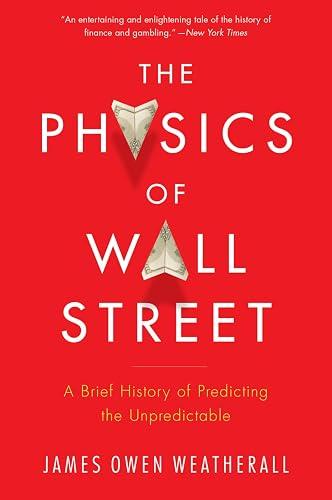
by James Owen Weatherall
Premium summary · Opens in the app · 30 min read
In the spring of 1900, a young French mathematician named Louis Bachelier defended his doctoral thesis at the Sorbonne. The thesis was titled "The Theory of Speculation," and it attempted something radical: applying the mathematics of probability to the movement of prices on the Paris stock exchange. Bachelier's advisor, the great Henri Poincaré, recognized the work as brilliant but unusual. The thesis received a mark of honorable rather than the highest distinction, a signal of how the mathemat
**Author:** James Owen Weatherall
**Estimated Reading Time:** 45 minutes
**What You'll Learn:** How physicists and mathematicians transformed finance, why their models succeeded and failed, and what the future of financial theory might look like.
**Who This Book Is For:** Anyone curious about the hidden mathematical machinery driving modern markets, from casual investors to professionals who want to understand the intellectual history behind the tools they use every day.
In the spring of 1900, a young French mathematician named Louis Bachelier defended his doctoral thesis at the Sorbonne. The thesis was titled "The Theory of Speculation," and it attempted something radical: applying the mathematics of probability to the movement of prices on the Paris stock exchange. Bachelier's advisor, the great Henri Poincaré, recognized the work as brilliant but unusual. The thesis received a mark of honorable rather than the highest distinction, a signal of how the mathematical establishment viewed this strange marriage of probability theory and finance. Bachelier's work languished in obscurity for more than half a century. When it was finally rediscovered, it became the foundation for an intellectual revolution that would transform global finance. The story of how physics came to dominate Wall Street is not a simple tale of smart people making money. It is a story about how ideas migrate across disciplines, how models shape reality, and how the tools we use to understand the world can sometimes change the world itself. It is also a cautionary tale about the limits of mathematical certainty when applied to human systems. Before the physicists arrived, finance was largely a craft. Traders relied on intuition, experience, and relationships. There was no rigorous theory of how prices moved, no mathematical framework for valuing options, no systematic approach to managing risk. The idea that you could model financial markets with the same tools used to study the motion of planets or the behavior of gases would have seemed absurd to most practitioners. But a series of remarkable individuals saw something that others missed. They recognized that financial markets, despite their apparent chaos, might exhibit patterns that could be understood mathematically. They brought tools from physics, probability theory, and eventually computer science to bear on the problem of understanding and predicting market behavior. The results were transformative. The Black-Scholes options pricing model, developed in the early 1970s, created an entirely new market for financial derivatives. The rise of quantitative trading firms in the 1980s and 1990s changed how stocks were bought and sold. Risk management became a mathematical discipline rather than a matter of judgment. By the early twenty-first century, physics had become the dominant intellectual framework for understanding finance. Yet this transformation came with a cost. The models that physicists brought to…
Continue reading in the MinuteRead app
Get the complete 30-minute summary of The Physics of Wall Street
Get the complete summary in the appStock prices follow a random walk, so short-term prediction is impossible.
The efficient market hypothesis holds that prices reflect all available information.
Market returns have fat tails, meaning extreme events are more common than standard models predict.
Mandelbrot's critique of standard finance was ignored for decades but vindicated by the 2008 crisis.
Ed Thorp proved that quantitative methods could beat both casinos and financial markets.
The Black-Scholes model created the modern derivatives market.
"The Physics of Wall Street" is a strong fit if you want practical ideas around economics, finance, science, especially themes like stock prices follow a random walk, so short-term prediction is impossible; the efficient market hypothesis holds that prices reflect all available information. The MinuteRead summary distills these concepts into a focused read, whether you're deciding whether to buy the book or applying its lessons at work.
Motivated to help readers with "Bachelier's work is referenced by a number of important mathematicians working in probability theory during, James Owen Weatherall wrote “The Physics of Wall Street” to package those ideas for a fast, focused read. In “The Physics of Wall Street”, James Owen Weatherall focuses on "Bachelier's work is referenced by a number of important mathematicians working in probability theory during. Through “The Physics of Wall Street”, James Owen Weatherall distills the core…
Continue Reading
Access the complete 30-minute summary and thousands more nonfiction books in the MinuteRead app.

Continue reading the complete summary in the MinuteRead app.