MinuteRead
30 min
Book summary
Premium summary · Opens in the app · 30 min read
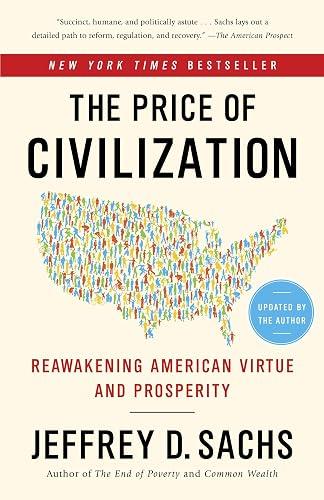
America stands at a crossroads unlike any it has faced since the Great Depression. The signs of trouble are everywhere: crumbling bridges and highways, schools that fail to prepare children for a competitive world, a healthcare system that costs more than any other on earth yet delivers mediocre results, and a political system paralyzed by partisan warfare and corporate money. But beneath these visible failures lies something more disturbing, something that Jeffrey Sachs argues is the true root
**Author:** Jeffrey D. Sachs
**Estimated Reading Time:** 45 minutes
**What You'll Learn:** Why America's economic crisis is fundamentally a moral crisis, how the retreat from public purpose has undermined prosperity, and what a mindful approach to citizenship and economic policy can do to restore the nation's promise.
**Who This Book Is For:** Anyone concerned about economic inequality, political dysfunction, and the erosion of civic life in America. This book is for citizens who sense that something deeper than economics has gone wrong and want to understand both the diagnosis and the path forward.
America stands at a crossroads unlike any it has faced since the Great Depression. The signs of trouble are everywhere: crumbling bridges and highways, schools that fail to prepare children for a competitive world, a healthcare system that costs more than any other on earth yet delivers mediocre results, and a political system paralyzed by partisan warfare and corporate money. But beneath these visible failures lies something more disturbing, something that Jeffrey Sachs argues is the true root of the crisis. The problem is not simply that the economy stopped growing or that globalization created new challenges. The problem is that America lost its way as a society. The nation forgot the basic principles of social responsibility that once guided its leaders and citizens alike. In their place arose a culture of hyper-consumerism, corporate greed, and political corruption that has left the country unable to solve even its most basic problems. Sachs writes as an economist, but his diagnosis reaches far beyond economics. He sees the financial collapse of 2008 not as a technical failure of regulation or risk management, but as a symptom of a deeper moral decay. When bankers knowingly sold worthless securities, when regulators looked the other way, when politicians dismantled the rules that had protected the system for decades, they were all making choices. Those choices reflected values. And those values had become dangerously distorted. The book's title captures this tension. Civilization has a price. It requires investment, sacrifice, and a willingness to think beyond one's own immediate interests. Someone has to pay for the roads, the schools, the courts, the research laboratories, the safety net. Someone has to think about the long term, about the next generation, about the common good. When the wealthiest and most powerful members of society decide they no longer want to pay that price, civilization itself begins to crumble. This is not a partisan argument. Sachs is careful to note that both political parties have contributed to the decline. The Democratic Party abandoned its working-class roots to chase Wall Street money. The Republican Party abandoned its tradition of fiscal responsibility to pursue tax cuts for the wealthy…
Continue reading in the MinuteRead app
Get the complete 30-minute summary of The Price of Civilization
Get the complete summary in the appAmerica's economic crisis is fundamentally a moral crisis caused by the decline of civic virtue among elites.
The free market cannot solve every problem. Public goods, externalities, and fairness require government action.
Since the 1980s, government has retreated from public purpose, leading to crumbling infrastructure and declining public
Corporate money has corrupted American democracy, making government serve the wealthy rather than the public.
The culture of distraction undermines democratic citizenship by keeping people focused on consumption rather than civic
The mindful society offers a path forward that balances material prosperity with spiritual and civic well-being.
"The Price of Civilization" is a strong fit if you want practical ideas around economics, politics, sociology, especially themes like america's economic crisis is fundamentally a moral crisis caused by the decline of civic virtue among elites; the free market cannot solve every problem. public goods, externalities, and fairness require government action. The MinuteRead summary distills these concepts into a focused read, whether you're deciding whether to buy the book or applying its lessons at work.
Motivated to help readers with at the root of America's economic crisis lies a moral crisis: the decline of civic virtue among America's, Jeffrey D. Sachs wrote “The Price of Civilization” to package those ideas for a fast, focused read. In “The Price of Civilization”, Jeffrey D. Sachs focuses on at the root of America's economic crisis lies a moral crisis: the decline of civic virtue among America's. Through “The Price of Civilization”, Jeffrey D. Sachs distills the core ideas on economics into…
View all summaries by Jeffrey D. SachsContinue Reading
Access the complete 30-minute summary and thousands more nonfiction books in the MinuteRead app.

Continue reading the complete summary in the MinuteRead app.