MinuteRead
16 min
Book summary
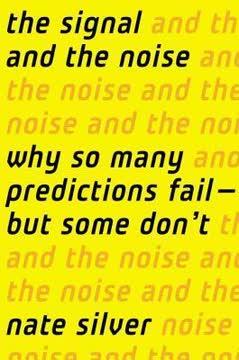
by Nate Silver
Premium summary · Opens in the app · 30 min read
We are drowning in information. Every day, humanity generates roughly 2.5 quintillion bytes of data. We track millions of economic indicators, monitor seismic activity across the globe, run thousands of political polls, and build computer models of extraordinary complexity. We have never had more facts at our fingertips.
**Why Most Predictions Fail: and Some Succeed**
By Nate Silver
**Estimated Reading Time:** 45 minutes
**What You'll Learn:** Why experts are often terrible at forecasting, how to think probabilistically in an uncertain world, and what separates the best predictors from the rest of us.
**Who This Book Is For:** Anyone who has ever trusted a weather forecast, invested in the stock market, followed political polls, or simply wanted to make better decisions under conditions of uncertainty.
We are drowning in information. Every day, humanity generates roughly 2.5 quintillion bytes of data. We track millions of economic indicators, monitor seismic activity across the globe, run thousands of political polls, and build computer models of extraordinary complexity. We have never had more facts at our fingertips.
And yet, most predictions still fail.
Why? Because more information does not automatically produce more understanding. The proliferation of data has multiplied the noise far faster than it has amplified the signal. We have built a civilization that runs on forecasts, but we have not built a civilization that understands how to make them well.
Nate Silver first encountered this problem as a teenager, obsessively analyzing baseball statistics. He later built PECOTA, a system for forecasting player performance that outperformed most professional scouts. Then he turned his attention to politics, where his model correctly predicted the winner in 49 of 50 states during the 2008 presidential election and all 50 states in 2012. Along the way, he became fascinated by a deeper question: why are some fields getting better at prediction while others remain stuck?
The answer, he discovered, is not about having better technology or more data. It is about a way of thinking.
The best forecasters share certain habits. They think in probabilities, not certainties. They update their beliefs when new evidence arrives. They seek out criticism and test their models against reality. They understand that being wrong is not a failure of character but an expected outcome in an uncertain world. And they know that the line between signal and noise is never perfectly clear.
This book is about that line. It is about why economic forecasters have been so consistently wrong, why earthquake prediction remains stubbornly impossible, and why meteorologists have quietly become some of the most accurate forecasters in the world. It is about poker players who win over the long run, political pundits who lose over the long run, and what each can teach us about thinking clearly.
Most of all, it is about a simple but profound idea: prediction is not a gift. It is a skill. And like any skill, it can be learned.
Continue reading in the MinuteRead app
Get the complete 30-minute summary of The Signal and the Noise
Get the complete summary in the appSeparate signal from noise. Most information is noise. Your job is to find the signal.
Think probabilistically. Never say something will happen. Say how likely it is.
Update your beliefs. When new evidence arrives, change your mind.
Be a fox, not a hedgehog. Know many things, not one big thing.
Seek feedback. Write down your predictions and compare them to reality.
Test out of sample. If a pattern only appears in the data you used to find it, it is probably noise.
"The Signal and the Noise" is a strong fit if you want practical ideas around science, business, economics—especially themes like separate signal from noise. most information is noise. your job is to find the signal; think probabilistically. never say something will happen. say how likely it is. The MinuteRead summary distills these concepts into a focused read, whether you're deciding whether to buy the book or applying its lessons at work.
Nathaniel Read "Nate" Silver is an American statistician and writer known for his accurate election predictions and baseball analytics. He gained recognition for developing PECOTA, a baseball player performance forecasting system, and later for his political blog FiveThirtyEight. Silver's accurate predictions in the 2008 and 2012 U.S. presidential elections garnered widespread attention. He has been named one of Time's 100 Most Influential People and has won multiple awards for his work. Silver'…
View all summaries by Nate SilverContinue Reading
Access the complete 30-minute summary and thousands more nonfiction books in the MinuteRead app.

Continue reading the complete summary in the MinuteRead app.