MinuteRead
30 min
Book summary
by describing how change keeps accelerating
Premium summary · Opens in the app · 5 min read
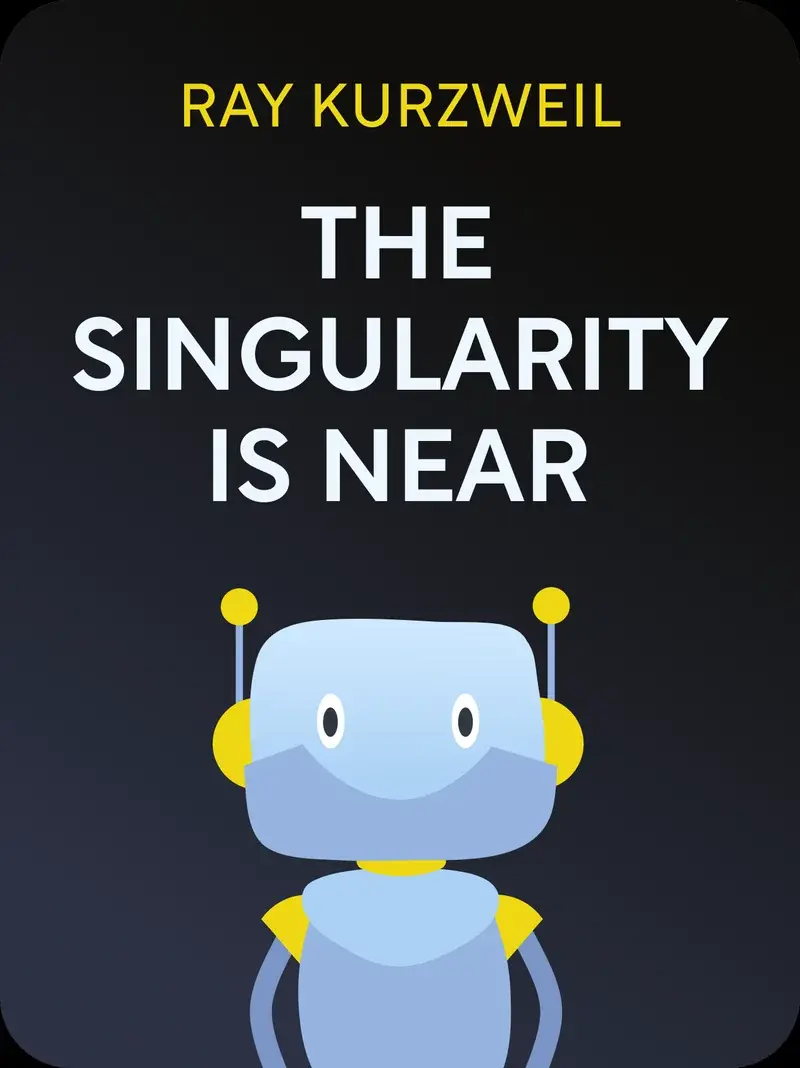
The Singularity Is Near outlines the future of technology by describing how change keeps accelerating, what computers will look like and be made of, why biology and technology will become indistinguishable and how we can’t possibly predict what’ll happen after 2045.
The Singularity Is Near outlines the future of technology by describing how change keeps accelerating, what computers will look like and be made of, why biology and technology will become indistinguishable and how we can’t possibly predict what’ll happen after 2045.
Take a second to think about all the changes your great-grandparents have seen in their lifetime. Mine have seen the rise of the car, the commercialization of aircraft travel and the first moonlanding. Now your grandparents. My grandma and grandpa are some of the few who manage to deal with smartphones and the internet somewhat decently.
Contrast that with what you’ve seen in just the last 15 years. The entire world is now connected. Cars start to drive themselves. You can carry most of the world’s knowledge in your pocket. Space rockets can be re-used.
The more time passes, the faster evolution brings about new changes. Around 4 billion years ago the process of evolution started. It took half of that time (2 billion years) JUST for multicellular organisms to develop from single-cell organisms. After that, the evolution from the first mammals to our homo sapiens took only 200 million years.
That’s not all though. According to Ray, what he calls the Law of Accelerating Returns says that in addition to the changes themselves, the benefits of those changes for humanity, the returns of evolution, are also increasing.
For example, if you look at the number of calculations per second a $1,000 computer can make used to double every three years until 1950. Then, until 1966, it doubled every two years. Now it doubles every year, making computers cheaper all the time.
Let’s transfer this accelerating rate of returns to a field that’s becoming more and more intertwined with technology: medicine. Can you imagine what medicine will look like 10-20 years from now, given that it’ll evolve faster every year? One example of such a next-level technology are nanobots. These mini-robots are so tiny that they can move through your entire body, for example using your bloodstream as a means of transport. You can imagine them as white blood cells on steroids. They’ll be able to eliminate bacteria, toxins or viruses from your body wherever they’re needed, keep your veins and arteries clean and remove chemical residues in your brain. Nanobots could even be used to deliver medicine just to specific cells, for example cancerous ones, or repair your genes when they’re damaged, for example from a sunburn. Apart from being controllable via the internet, these nanobots will be able to self-replicate, meaning they can make however many copies they need of themselves, in order to take care of your body. You’ll just have to go to the doctor…
Continue reading in the MinuteRead app
Get the complete 5-minute summary of The Singularity Is Near
Get the complete summary in the appThe speed of evolution increases every year, according to the Law of Accelerating Returns.
Your doctor will soon be out of a job, because nanobots will repair your body from the inside.
If the nanobots spin out of control, we’re all doomed.
"The Singularity Is Near" is a strong fit if you want practical ideas around culture, future, science, especially themes like the speed of evolution increases every year, according to the law of accelerating returns; your doctor will soon be out of a job, because nanobots will repair your body from the inside. The MinuteRead summary distills these concepts into a focused read, whether you're deciding whether to buy the book or applying its lessons at work.
Ray Kurzweil is a world class inventor, thinker, and futurist, with a thirty-five-year track record of accurate predictions. He has been a leading developer in artificial intelligence for 61 years – longer than any other living person. He was the principal inventor of the first CCD flat-bed scanner, omni-font optical character recognition, print-to-speech reading machine for the blind, text-to-speech synthesizer, music synthesizer capable of recreating the grand piano and other orchestral instru…
View all summaries by describing how change keeps acceleratingContinue Reading
Access the complete 5-minute summary and thousands more nonfiction books in the MinuteRead app.

Continue reading the complete summary in the MinuteRead app.