MinuteRead
30 min
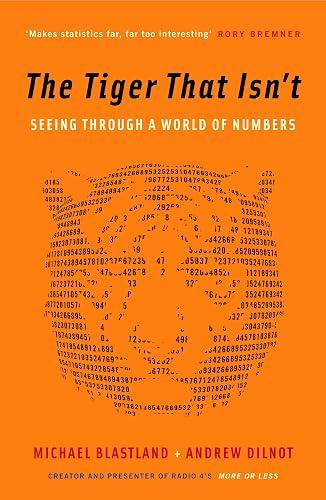
Book summary
by Michael Blastland
Premium summary · Opens in the app · 30 min read
Imagine walking through a forest at dusk. Out of the corner of your eye, you spot stripes moving through the undergrowth. Your heart races. A tiger. You freeze, adrenaline surging, preparing to run or fight. But when you look again, carefully, you realize it was only the play of light and shadow through tall grass. The tiger that seemed so real was never there at all.
**Author:** Michael Blastland and Andrew Dilnot
**Estimated Reading Time:** 2 hours 15 minutes
**What You'll Learn:** How to see through misleading statistics, understand what numbers actually mean, and make better decisions in a world saturated with data.
**Who This Book Is For:** Anyone who has ever felt confused, manipulated, or uncertain when confronted with statistics in the news, at work, or in daily life.
Imagine walking through a forest at dusk. Out of the corner of your eye, you spot stripes moving through the undergrowth. Your heart races. A tiger. You freeze, adrenaline surging, preparing to run or fight. But when you look again, carefully, you realize it was only the play of light and shadow through tall grass. The tiger that seemed so real was never there at all. This is the central metaphor of Michael Blastland and Andrew Dilnot's remarkable book. The modern world is full of statistical tigers: numbers that seem terrifying, certain, and urgent, but that dissolve into nothing when examined closely. A headline screams that a certain food increases cancer risk by fifty percent. A politician announces that crime has fallen dramatically. A news report claims that your neighborhood is a cancer cluster. Each of these claims carries the weight of numbers, and numbers feel solid, objective, and true. But numbers are not reality. Numbers are representations of reality, created by human beings who make choices about what to count, how to count it, and what to leave out. Every statistic you encounter is the product of countless decisions, assumptions, and compromises. The unemployment rate depends on how you define "unemployed." The cancer risk depends on what baseline you compare against. The crime statistics depend on what crimes get reported and how they get recorded. The problem is that most of us were taught to treat numbers as neutral facts. We learned arithmetic in school, where numbers behaved predictably and followed clear rules. Two plus two always equaled four. A percentage was a percentage. An average was an average. But the numbers we encounter in real life are not like the numbers in textbooks. They are messy, contested, and often deliberately manipulated. Blastland and Dilnot created the BBC Radio 4 program "More or Less" to help ordinary people understand statistics in public life. Through years of investigating statistical claims, they discovered that most misleading numbers are not the result of deliberate lies. Instead, they arise from something more subtle: the gap between what we think numbers mean and what they actually measure. A statistic can be technically accurate and still deeply misleading if we don't understand its context. Consider a simple example. A newspaper reports that eating bacon increases your risk of bowel cancer by…
Continue reading in the MinuteRead app
Get the complete 30-minute summary of The Tiger That Isn't
Get the complete summary in the app**Numbers are not reality.** They are representations created by people who make choices. Always ask what lies behind th
**Averages hide variation.** The "average person" often doesn't exist. Always ask about the distribution.
**Chance plays a bigger role than you think.** Random events cluster naturally. Before seeing a pattern, ask if it could
**Regression to the mean is real.** Extreme results are often followed by more average ones. Don't attribute to skill wh
**Relative risk is misleading without baseline.** A 50 percent increase in a tiny risk is still tiny. Always ask for abs
**Natural frequencies are clearer than percentages.** "5 in 100" beats "5 percent" for understanding.
"The Tiger That Isn't" is a strong fit if you want practical ideas around science, mathematics, economics, especially themes like **numbers are not reality.** they are representations created by people who make choices. always ask what lies behind th; **averages hide variation.** the "average person" often doesn't exist. always ask about the distribution. The MinuteRead summary distills these concepts into a focused read, whether you're deciding whether to buy the book or applying its lessons at work.
Motivated to help readers with numbers, Michael Blastland wrote “The Tiger That Isn't” to package those ideas for a fast, focused read. In “The Tiger That Isn't”, Michael Blastland focuses on numbers. Through “The Tiger That Isn't”, Michael Blastland distills the core ideas on science into lessons readers can absorb in a single short sitting. Readers turn to this work when they want Michael Blastland's perspective on the subject without working through the entire original volume. Michael Blastla…
Continue Reading
Access the complete 30-minute summary and thousands more nonfiction books in the MinuteRead app.

Continue reading the complete summary in the MinuteRead app.