MinuteRead
30 min
Book summary
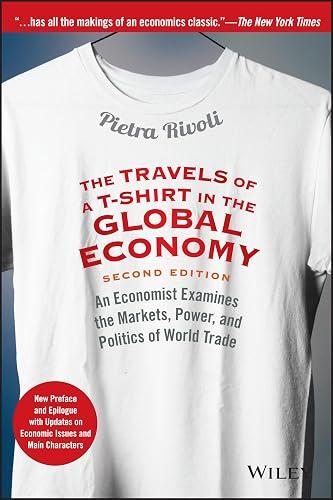
by Pietra Rivoli
Premium summary · Opens in the app · 30 min read
Every day, millions of people pull a T-shirt over their heads without giving it a second thought. It is perhaps the most ordinary garment in the world. It is also one of the most extraordinary.
**Author:** Pietra Rivoli
**Estimated Reading Time:** 45 minutes
**What You'll Learn:**
- Why the global economy is far more complex than either free-market advocates or critics believe - How a simple cotton T-shirt connects Texas farmers, Chinese factory workers, African market traders, and American consumers - Why government intervention shapes nearly every stage of global trade - How used clothing becomes one of the world's most entrepreneurial industries - What the journey of a T-shirt reveals about globalization's winners, losers, and unexpected beneficiaries
**Who This Book Is For:**
Anyone who has ever wondered where their clothes come from, who made them, and what happens to them after they are donated. This book is for readers who want to understand globalization beyond slogans and headlines, for students of economics and business, and for anyone curious about the hidden connections that bind the world together.
Every day, millions of people pull a T-shirt over their heads without giving it a second thought. It is perhaps the most ordinary garment in the world. It is also one of the most extraordinary. A simple cotton T-shirt begins its life as a seed planted in the soil of West Texas. That seed grows into a plant, which produces cotton, which is harvested, ginned, baled, and shipped across an ocean. The cotton becomes yarn, the yarn becomes fabric, the fabric is cut and sewn into a shirt, and the shirt is packed into a container and shipped back across the ocean to a store shelf in America. After a few years of wear, the shirt is donated to a charity, sold to a recycler, baled again, and shipped to Africa, where it begins a second life in a bustling market stall. This journey spans continents, crosses borders, and passes through the hands of farmers, factory workers, traders, politicians, activists, and entrepreneurs. Each stop along the way reveals something important about how the global economy actually works. Pietra Rivoli, an economist at Georgetown University, set out to trace this journey. She wanted to understand the real story behind the debates about globalization that dominated the late twentieth and early twenty-first centuries. On one side stood the champions of free markets, who argued that removing barriers to trade would unleash prosperity around the world. On the other side stood the critics, who saw globalization as a race to the bottom, exploiting workers and destroying communities. Rivoli suspected that neither story was complete. She suspected that the truth was messier, more interesting, and more human than either side acknowledged. So she followed the T-shirt. What she discovered was that markets are never truly free. They are shaped at every turn by politics, by history, by institutions, and by the…
Continue reading in the MinuteRead app
Get the complete 30-minute summary of The Travels of a T-Shirt in the Global Economy
Get the complete summary in the appMarkets are never truly free. They are shaped by politics, institutions, and history at every stage.
American cotton dominance depends on a virtuous circle of innovation involving farmers, researchers, and government supp
China's apparel industry thrives on more than cheap labor. The hukou system creates a flexible workforce that is central
Textiles and apparel are among the most protected industries in the global economy, governed by a complex web of quotas,
Trade barriers often produce unintended consequences, including the development of apparel industries in unexpected plac
The used clothing trade is a rare example of genuine free enterprise in the global economy, dominated by small-scale ent
"The Travels of a T-Shirt in the Global Economy" is a strong fit if you want practical ideas around economics, business, politics, especially themes like markets are never truly free. they are shaped by politics, institutions, and history at every stage; american cotton dominance depends on a virtuous circle of innovation involving farmers, researchers, and government supp. The MinuteRead summary distills these concepts into a focused read, whether you're deciding whether to buy the book or applying its lessons at work.
Motivated to help readers with to either glorify or vilify the markets is to dangerously oversimplify the world of trade, Pietra Rivoli wrote “The Travels of a T-Shirt in the Global Economy” to package those ideas for a fast, focused read. In “The Travels of a T-Shirt in the Global Economy”, Pietra Rivoli focuses on to either glorify or vilify the markets is to dangerously oversimplify the world of trade. Through “The Travels of a T-Shirt in the Global Economy”, Pietra Rivoli distills the core i…
Continue Reading
Access the complete 30-minute summary and thousands more nonfiction books in the MinuteRead app.

Continue reading the complete summary in the MinuteRead app.