MinuteRead
30 min
Book summary
Premium summary · Opens in the app · 30 min read
In the fall of 1906, the British scientist Francis Galton visited a country fair in Plymouth, England. Galton was a man of strong opinions, and one of his strongest was that the average person was dangerously incompetent. He had spent much of his career arguing that society should be managed by an elite few, because the masses simply could not be trusted with important decisions.
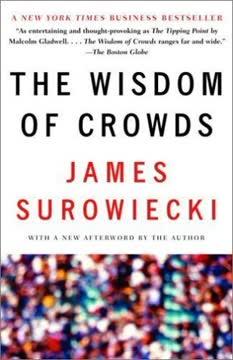
**Author:** James Surowiecki **Estimated Reading Time:** 45 minutes
**What You'll Learn:** Why groups, under the right conditions, consistently outperform even the smartest individuals within them. You will discover the four essential conditions that make crowds wise, understand when and why groups fail spectacularly, and learn practical ways to harness collective intelligence in your own life, work, and community.
**Who This Book Is For:** Anyone who makes decisions in groups, which is to say, nearly everyone. Managers who want better team outcomes. Investors trying to understand market behavior. Citizens curious about how democracy actually works. And anyone who has ever wondered why a diverse committee sometimes produces brilliance and other times produces disaster.
In the fall of 1906, the British scientist Francis Galton visited a country fair in Plymouth, England. Galton was a man of strong opinions, and one of his strongest was that the average person was dangerously incompetent. He had spent much of his career arguing that society should be managed by an elite few, because the masses simply could not be trusted with important decisions. At the fair, Galton encountered a weight-judging competition. A fat ox had been put on display, and fairgoers were invited to guess its weight after it had been slaughtered and dressed. For sixpence, anyone could submit a ticket with their estimate. The person closest to the actual weight would win a prize. Galton, ever the scientist, saw an opportunity. He collected all 787 tickets after the contest ended and subjected them to statistical analysis. What he found shocked him. Not a single person guessed the correct weight of 1,198 pounds. The closest estimate was 1,207 pounds, still nine pounds off. But when Galton calculated the average of all 787 guesses, the result was 1,197 pounds. The collective judgment of this diverse crowd, most of whom knew nothing about cattle, was off by a single pound. The crowd had outperformed every individual in it, including the butchers and farmers who might have been considered experts. Galton walked away from that fair a changed man. The experience forced him to reconsider his deepest assumptions about human capability. The crowd, it turned out, possessed a kind of intelligence that no single person could match. This book exists because Galton's discovery was not a fluke. It was a glimpse into a profound truth about how human beings think together. Under the right circumstances, groups are remarkably intelligent. They are often smarter than the smartest people in them. This is not mysticism or wishful thinking. It is a demonstrable fact with enormous implications for how we run businesses, govern societies, and make decisions in our daily lives. The problem is that most of us do not understand how…
Continue reading in the MinuteRead app
Get the complete 30-minute summary of The Wisdom of Crowds
Get the complete summary in the appUnder the right conditions, groups are smarter than the smartest individuals in them.
The four conditions for wise crowds are diversity, independence, decentralization, and aggregation.
Diversity works because uncorrelated errors cancel each other out when judgments are averaged.
Independence means forming your own judgment. Imitating others destroys collective wisdom.
Decentralization allows people to act on local knowledge that central authorities cannot access.
Markets and prediction markets are powerful aggregation mechanisms that turn dispersed information into collective judgm
"The Wisdom of Crowds" is a strong fit if you want practical ideas around psychology, business, economics—especially themes like under the right conditions, groups are smarter than the smartest individuals in them; the four conditions for wise crowds are diversity, independence, decentralization, and aggregation. The MinuteRead summary distills these concepts into a focused read, whether you're deciding whether to buy the book or applying its lessons at work.
James Surowiecki is a respected financial journalist and author known for his work at The New Yorker, where he has been a staff writer since 2000. He writes The Financial Page and has contributed to various prestigious publications, including Fortune, The Wall Street Journal, and Wired. Surowiecki's diverse writing portfolio covers topics ranging from business and economics to sports and technology. His book "The Wisdom of Crowds" (2004) explores collective intelligence and decision-making, soli…
View all summaries by James SurowieckiContinue Reading
Access the complete 30-minute summary and thousands more nonfiction books in the MinuteRead app.

Continue reading the complete summary in the MinuteRead app.