MinuteRead
30 min
Book summary
Premium summary · Opens in the app · 30 min read
Every economic system eventually reaches a point where its own success creates the conditions for its transformation. The feudal economy gave way to the market economy when new technologies made centralized production and long-distance trade more efficient than manorial self-sufficiency. The market economy gave way to industrial capitalism when the steam engine and the factory system made mass production possible. Now, Jeremy Rifkin argues, capitalism is approaching its own inflection point. The
**Author:** Jeremy Rifkin
**Estimated Reading Time:** 45 minutes
**What You'll Learn:**
- Why the fundamental logic of capitalism is colliding with a new technological reality - How near-zero marginal costs are transforming production, energy, education, and work - What the Collaborative Commons is and why it represents a genuine economic paradigm shift - How the Internet of Things connects energy, logistics, and communication into a single intelligent infrastructure - What the rise of the prosumer means for the future of ownership, labor, and value creation - How to position yourself for the transition from markets to networks
**Who This Book Is For:**
This book is for anyone who senses that something profound is shifting beneath the surface of the economy. It is for entrepreneurs wondering why traditional business models are failing, for workers anxious about automation, for students questioning the value of expensive credentials, for policymakers trying to govern technologies that evolve faster than laws, and for citizens who want to understand the forces reshaping daily life. If you have ever felt that the old economic rules no longer explain the world around you, this book offers a coherent framework for understanding what comes next.
Every economic system eventually reaches a point where its own success creates the conditions for its transformation. The feudal economy gave way to the market economy when new technologies made centralized production and long-distance trade more efficient than manorial self-sufficiency. The market economy gave way to industrial capitalism when the steam engine and the factory system made mass production possible. Now, Jeremy Rifkin argues, capitalism is approaching its own inflection point. The very technologies that made capitalism the most productive economic system in history are now undermining its foundational logic. The problem is simple to state but difficult to accept. Capitalism depends on scarcity. Profit exists because there is a gap between the cost of producing something and the price someone is willing to pay for it. When the cost of producing an additional unit of something approaches zero, that gap disappears. And when the gap disappears, the market mechanism that has organized economic life for centuries begins to break down. This is not a distant hypothetical. It is already happening in industries that once seemed unshakable. The music industry collapsed when digital reproduction drove the marginal cost of a song to zero. The publishing industry is undergoing the same transformation. Newspapers, encyclopedias, and textbooks have already been disrupted. Now the same forces are moving into manufacturing, energy, education, and even professional services. The question is no longer whether this transformation will occur, but how quickly and with what consequences. Rifkin is not the first observer to notice these trends, but he offers something more…
Continue reading in the MinuteRead app
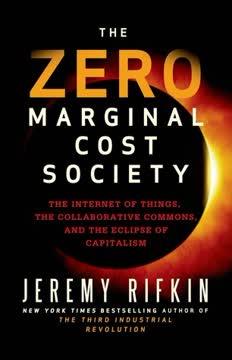
Get the complete 30-minute summary of The Zero Marginal Cost Society
Get the complete summary in the appMarginal cost is the cost of producing one additional unit. When it approaches zero, capitalism stops working.
The Collaborative Commons is a new economic paradigm based on sharing, cooperation, and social value.
The Internet of Things is the convergence of communication, energy, and logistics networks into a single intelligent inf
Three-dimensional printing is democratizing manufacturing, enabling anyone to become a producer.
Massive open online courses are driving the marginal cost of education toward zero.
Automation is driving the marginal cost of labor toward zero, challenging the link between work and income.
"The Zero Marginal Cost Society" is a strong fit if you want practical ideas around economics, business, politics, especially themes like marginal cost is the cost of producing one additional unit. when it approaches zero, capitalism stops working; the collaborative commons is a new economic paradigm based on sharing, cooperation, and social value. The MinuteRead summary distills these concepts into a focused read, whether you're deciding whether to buy the book or applying its lessons at work.
Jeremy Rifkin is an influential American economic and social theorist known for his prolific writing and public speaking on emerging technological trends and their impact on society. As an activist and political advisor, Rifkin has been at the forefront of discussions about the future of work, energy, and the economy. His books often explore how technological advancements are reshaping human consciousness and social structures. Rifkin's ideas have garnered both praise and criticism, with some vi…
View all summaries by Jeremy RifkinContinue Reading
Access the complete 30-minute summary and thousands more nonfiction books in the MinuteRead app.

Continue reading the complete summary in the MinuteRead app.