MinuteRead
30 min
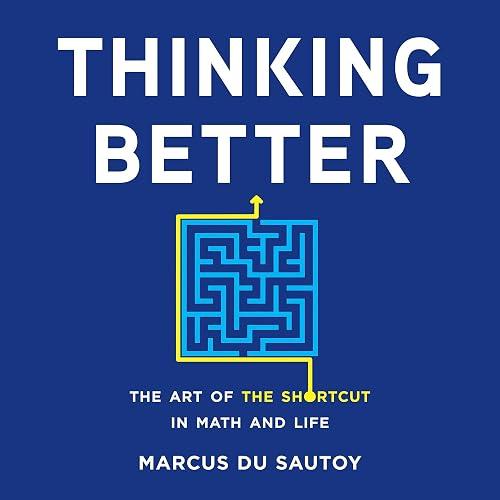
Book summary
by Marcus du Sautoy
Premium summary · Opens in the app · 30 min read
Every great leap forward in human understanding has come from someone asking a simple question: Is there a faster way?
**Author:** Marcus du Sautoy
**Estimated Reading Time:** 45 minutes
**What You'll Learn:**
- Why mathematics is fundamentally the art of finding clever shortcuts - How patterns, diagrams, and language compress complex ideas into manageable forms - The power of calculus, statistics, and network theory to solve real problems - Why some problems resist shortcuts entirely, and why that matters - How to apply mathematical thinking to your own decisions and work
**Who This Book Is For:**
Anyone who has ever wondered whether there is a smarter way to solve a problem. You do not need a background in mathematics. You only need curiosity about how the best thinkers find elegant paths through complexity.
Every great leap forward in human understanding has come from someone asking a simple question: Is there a faster way? When Carl Friedrich Gauss was a schoolboy in late eighteenth-century Germany, his teacher gave the class a tedious task. Add up all the numbers from 1 to 100. The teacher expected this to keep the students quiet for a long while. Most children began the slow grind: one plus two is three, plus three is six, plus four is ten. Gauss sat quietly for a moment. Then he wrote down a single number: 5,050. The teacher was astonished. Gauss had not added the numbers one by one. He had noticed something. Pair the first number with the last: 1 plus 100 equals 101. Pair the second with the second-to-last: 2 plus 99 equals 101. There are fifty such pairs. Fifty times 101 is 5,050. The problem that should have taken an hour took seconds. When the teacher announced that this was mathematics, he was not talking about arithmetic. He was talking about the art of the shortcut. Marcus du Sautoy, one of Britain's most celebrated mathematicians, has spent his career exploring this idea. Mathematics, he argues, is not really about numbers. It is about finding clever ways to navigate through difficult terrain. It is about seeing structure where others see only chaos. It is about replacing hard work with smart work. This matters far beyond the classroom. Every day, you face problems that resemble Gauss's challenge. You have limited time, limited information, and limited energy. The question is whether you will grind through every step or find a smarter path. Consider how often you rely on shortcuts without realizing it. When you use a map app to find the fastest route across a city, you are using algorithms built on mathematical shortcuts. When a doctor diagnoses an illness from a few symptoms, she is using probabilistic reasoning refined over centuries. When a company predicts demand for a product, it is applying statistical models that compress vast amounts…
Continue reading in the MinuteRead app
Get the complete 30-minute summary of Thinking Better
Get the complete summary in the appMathematics is the art of finding clever shortcuts, not grinding through calculations.
Patterns compress infinite information into simple rules that allow prediction.
The right notation or diagram can make impossible problems trivial.
Calculus finds optimal solutions by setting the derivative to zero.
Statistics makes confident decisions from limited data possible.
Networks have structure, and understanding that structure helps you navigate complex systems.
"Thinking Better" is a strong fit if you want practical ideas around science, mathematics, self help, especially themes like mathematics is the art of finding clever shortcuts, not grinding through calculations; patterns compress infinite information into simple rules that allow prediction. The MinuteRead summary distills these concepts into a focused read, whether you're deciding whether to buy the book or applying its lessons at work.
Motivated to help readers with "That, Marcus du Sautoy wrote “Thinking Better” to package those ideas for a fast, focused read. In “Thinking Better”, Marcus du Sautoy focuses on "That. Through “Thinking Better”, Marcus du Sautoy distills the core ideas on science into lessons readers can absorb in a single short sitting. Readers turn to this work when they want Marcus du Sautoy's perspective on the subject without working through the entire original volume. Marcus Peter Francis du Sautoy (; born…
Continue Reading
Access the complete 30-minute summary and thousands more nonfiction books in the MinuteRead app.

Continue reading the complete summary in the MinuteRead app.