MinuteRead
30 min
Book summary
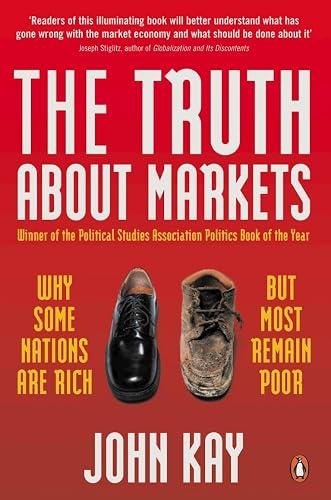
by John Kay
Premium summary · Opens in the app · 30 min read
Most people hold one of two views about markets. Either they believe markets are magnificent engines of prosperity that should be left alone to work their magic, or they believe markets are dangerous forces that enrich the few at the expense of the many and must be tightly controlled. Both views are wrong. Both views are also, in their own way, comforting. They offer simple answers to complex questions. They tell us whom to praise and whom to blame. They relieve us of the burden of thinking care
**Author:** John Kay
**Estimated Reading Time:** 45 minutes
**What You'll Learn:**
* Why markets are not the perfectly efficient machines of economic theory * How institutions, culture, and history shape economic outcomes more than policy * Why knowledge and innovation, not capital, drive modern prosperity * How risk, uncertainty, and human psychology actually govern economic decisions * Why cooperation and trust are the hidden foundations of market economies * What really determines who gets what in a market economy * Why development cannot be achieved through capital and technology transfer alone
**Who This Book Is For:**
This book is for anyone who has sensed that the standard economic story is incomplete. It is for business leaders who have watched elegant strategies fail in messy real-world markets. It is for policymakers who have seen textbook solutions produce unexpected results. It is for students who want a richer understanding of how economies actually work. And it is for curious readers who suspect that the truth about markets is more interesting than the simplified version they have been taught.
Most people hold one of two views about markets. Either they believe markets are magnificent engines of prosperity that should be left alone to work their magic, or they believe markets are dangerous forces that enrich the few at the expense of the many and must be tightly controlled. Both views are wrong. Both views are also, in their own way, comforting. They offer simple answers to complex questions. They tell us whom to praise and whom to blame. They relieve us of the burden of thinking carefully about how economic life actually functions. John Kay spent decades working across the boundaries of economic theory and practice. He taught at Oxford, directed a think tank, built a consulting firm, and advised governments and corporations. Along the way, he discovered something uncomfortable. The elegant models he had learned and taught did not describe the world he encountered. The markets he observed were messier, more interesting, and far less predictable than the textbooks suggested. They were populated not by the calculating rational agents of economic theory but by real human beings with limited information, conflicting emotions, and deeply social natures. This book is an attempt to tell the truth about markets. Not the truth as defined by ideology, whether pro-market or anti-market. Not the truth as simplified by mathematical models that sacrifice accuracy for tractability. But the truth as revealed by careful observation of how markets actually work in the real world. The central problem is that modern economics has become disconnected from economic reality. The discipline has developed impressive mathematical tools and elegant theoretical frameworks. But these tools often describe a world that does not…
Continue reading in the MinuteRead app
Get the complete 30-minute summary of The Truth About Markets
Get the complete summary in the appMarkets are complex adaptive systems, not perfectly efficient machines. They evolve unpredictably through the interactio
Institutions matter more than resources. The quality of rules, norms, and governance determines economic success more th
Knowledge drives modern economies. Its unique properties, non-rival, partially excludable, and cumulative, have transfor
Human behavior under uncertainty is shaped by psychology, not rational calculation. Biases like overconfidence, loss ave
Cooperation and trust are the hidden foundations of markets. Without them, the complex division of labor would be imposs
Income distribution reflects bargaining power and economic rents, not just productivity. Position and power often matter
"The Truth About Markets" is a strong fit if you want practical ideas around economics, business, politics, especially themes like markets are complex adaptive systems, not perfectly efficient machines. they evolve unpredictably through the interactio; institutions matter more than resources. the quality of rules, norms, and governance determines economic success more th. The MinuteRead summary distills these concepts into a focused read, whether you're deciding whether to buy the book or applying its lessons at work.
Motivated to help readers with much more complex, John Kay wrote “The Truth About Markets” to package those ideas for a fast, focused read. In “The Truth About Markets”, John Kay focuses on much more complex. Through “The Truth About Markets”, John Kay distills the core ideas on economics into lessons readers can absorb in a single short sitting. Readers turn to this work when they want John Kay's perspective on the subject without working through the entire original volume. The Truth About Mark…
Continue Reading
Access the complete 30-minute summary and thousands more nonfiction books in the MinuteRead app.

Continue reading the complete summary in the MinuteRead app.