MinuteRead
30 min
Book summary
by Otto Kroeger
Premium summary · Opens in the app · 30 min read
There is a moment in nearly every relationship when you look at another person and think, "What is wrong with you?" It might happen when your spouse spends an hour analyzing a decision you would make in thirty seconds. It might happen when your boss demands a detailed plan for a project you would rather figure out as you go. It might happen when your child refuses to speak at dinner after a long day at school, or when your friend talks through every thought the moment it enters their head.
**Author:** Otto Kroeger
**Estimated Reading Time:** 45 minutes
**What You'll Learn**
Why people who seem impossible to understand are actually operating from a completely different set of preferences than you are. How to decode the four dimensions of personality that shape every conversation, decision, and conflict. What to do when your natural way of being collides with someone else's. How to use this knowledge to improve your relationships, your work, and your understanding of yourself.
**Who This Book Is For**
Anyone who has ever thought, "Why would they do that?" Anyone who manages people, raises children, navigates a marriage, or simply wants to understand why some interactions feel effortless while others feel like pushing a boulder uphill. This book is for people who are tired of judging others and ready to understand them instead.
There is a moment in nearly every relationship when you look at another person and think, "What is wrong with you?" It might happen when your spouse spends an hour analyzing a decision you would make in thirty seconds. It might happen when your boss demands a detailed plan for a project you would rather figure out as you go. It might happen when your child refuses to speak at dinner after a long day at school, or when your friend talks through every thought the moment it enters their head. In that moment, you have a choice. You can decide that the other person is broken, difficult, or deliberately annoying. Or you can consider another possibility: they are not broken at all. They are simply wired differently than you are. This book is about that second possibility. The central insight of *Type Talk* is both simple and profound. Most of the friction in human relationships comes not from malice, stupidity, or bad intentions. It comes from the fact that different people genuinely experience the world in different ways. They notice different things. They make decisions using different criteria. They organize their lives according to different rhythms. And they assume, naturally but incorrectly, that everyone else operates the way they do. The problem is that we rarely see our own preferences as preferences. We see them as reality. An extravert assumes that talking things through is simply how thinking works. An introvert assumes that needing quiet reflection is simply what being thoughtful means. A judging type assumes that having a plan is simply what being responsible looks like. A perceiving type assumes that staying open to new information is simply what being smart looks like. When someone violates these assumptions, we do not think, "Ah, they have a different preference." We think, "They are wrong." Or worse, "They are wrong on purpose." The framework in this…
Continue reading in the MinuteRead app
Get the complete 30-minute summary of Type Talk
Get the complete summary in the appPeople are different. Those differences follow patterns. Those patterns can be understood.
Extraversion and introversion are about energy, not sociability. Extraverts are energized by interaction. Introverts are
Sensing types focus on concrete realities. Intuitive types focus on abstract possibilities. Both are necessary.
Thinking types decide based on logic. Feeling types decide based on values. The best decisions incorporate both.
Judging types prefer structure. Perceiving types prefer flexibility. Both approaches have strengths.
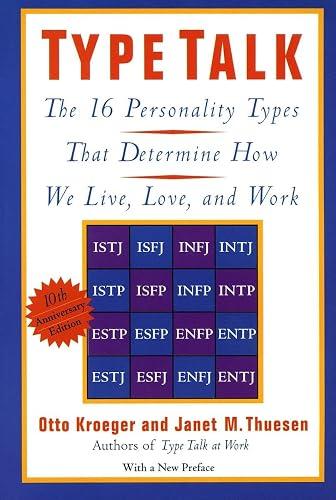
The four dimensions combine into sixteen types. No type is better than another.
"Type Talk" is a strong fit if you want practical ideas around psychology, self help, reference, especially themes like people are different. those differences follow patterns. those patterns can be understood; extraversion and introversion are about energy, not sociability. extraverts are energized by interaction. introverts are. The MinuteRead summary distills these concepts into a focused read, whether you're deciding whether to buy the book or applying its lessons at work.
Motivated to help readers with "Typewatching is a constructive response to the inevitability of name-calling." Understanding differences, Otto Kroeger wrote “Type Talk” to package those ideas for a fast, focused read. In “Type Talk”, Otto Kroeger focuses on "Typewatching is a constructive response to the inevitability of name-calling." Understanding differences. Through “Type Talk”, Otto Kroeger distills the core ideas on psychology into lessons readers can absorb in a single short sitting. Read…
Continue Reading
Access the complete 30-minute summary and thousands more nonfiction books in the MinuteRead app.

Continue reading the complete summary in the MinuteRead app.