MinuteRead
30 min
Book summary
by Brian Greene
Premium summary · Opens in the app · 30 min read
Every culture that has ever existed has asked the same questions. Where did we come from? Why are we here? What happens when we die? These questions have inspired myths, religions, philosophies, and scientific investigations for thousands of years. They are the questions that define what it means to be human.
**Author:** Brian Greene
**Estimated Reading Time:** 45 minutes
**What You'll Learn:** How the fundamental laws of physics shape the emergence of life, consciousness, creativity, and meaning, and what the far future holds for everything that exists.
**Who This Book Is For:** Readers who want to understand the grand arc of existence, from the birth of the universe to the final moments of time, and who are willing to sit with both the wonder and the melancholy that such knowledge brings.
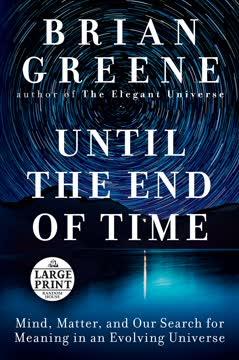
Every culture that has ever existed has asked the same questions. Where did we come from? Why are we here? What happens when we die? These questions have inspired myths, religions, philosophies, and scientific investigations for thousands of years. They are the questions that define what it means to be human. Brian Greene's *Until the End of Time* takes these ancient questions and examines them through the lens of modern physics. But this is not a book that simply explains scientific concepts. It is a meditation on the deepest truths we have discovered about the nature of reality, and what those truths mean for how we live our lives. The central tension of the book is this: science has revealed a universe that is vast, ancient, and ultimately indifferent to human concerns. The laws of physics suggest that everything we know, everything we love, everything we create, will eventually dissolve into a cold, dark, empty cosmos. And yet, within this same universe, matter has organized itself into beings capable of asking why. Beings capable of love, creativity, wonder, and the search for meaning. Greene's approach is distinctive because he refuses to flinch from either side of this tension. He does not offer false comfort. He does not suggest that science has somehow revealed a hidden purpose to existence. But he also does not descend into nihilism. Instead, he shows how the very laws that doom the universe to eventual dissolution are the same laws that made possible everything we value. The book moves through multiple scales of time and space. It begins with the origins of the universe and the fundamental laws that govern its evolution. It traces the emergence of life from complex chemistry, the development of consciousness from neural processes, and the flowering of human culture from our capacity for language and storytelling. It examines religion and art as responses to our awareness of mortality. And finally, it looks forward to the far future, when the universe will undergo transformations that challenge our ability to even imagine existence. What makes this book remarkable is Greene's ability to hold together two seemingly contradictory perspectives. On one hand, he presents the cold, mathematical truths of physics with unflinching clarity. On…
Continue reading in the MinuteRead app
Get the complete 30-minute summary of Until the End of Time
Get the complete summary in the appThe universe began in a low-entropy state, and this is the source of all structure and complexity.
Entropy always increases overall, but local order can emerge through the entropic two-step.
Life emerged from complex chemistry through a process of variation and selection.
Consciousness is a physical phenomenon, and free will may be an illusion.
Language and storytelling are evolutionary adaptations that shape our perception of reality.
Religion and art are responses to our awareness of mortality.
"Until the End of Time" is a strong fit if you want practical ideas around science, physics, philosophy, especially themes like the universe began in a low-entropy state, and this is the source of all structure and complexity; entropy always increases overall, but local order can emerge through the entropic two-step. The MinuteRead summary distills these concepts into a focused read, whether you're deciding whether to buy the book or applying its lessons at work.
Brian Randolph Greene is an American theoretical physicist, mathematician, and popular science writer. He has been a professor at Columbia University since 1996 and co-founded the World Science Festival in 2008. Greene's research focuses on string theory, including work on mirror symmetry and topology changes. He gained widespread recognition through his bestselling books and PBS specials, which explain complex scientific concepts to general audiences. Greene has also made appearances in popular…
View all summaries by Brian GreeneContinue Reading
Access the complete 30-minute summary and thousands more nonfiction books in the MinuteRead app.

Continue reading the complete summary in the MinuteRead app.