MinuteRead
30 min
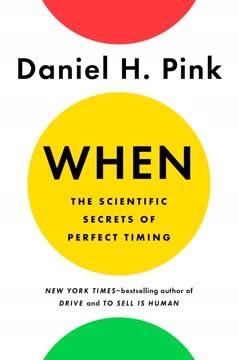
We make countless decisions about what to do and how to do it. We agonize over strategy, technique, and execution. We read books about motivation, productivity, and habit formation. But we rarely ask a question that turns out to be just as important: when?
**When: The Scientific Secrets of Perfect Timing** By Daniel H. Pink
**Estimated Reading Time:** 45 minutes
**What You'll Learn** Why the time of day you do something matters just as much as what you do and how you do it. You will discover the hidden science of daily rhythms, learn to identify your personal chronotype, understand why beginnings and endings carry disproportionate weight, and master practical strategies for scheduling your work, breaks, and important decisions for maximum impact.
**Who This Book Is For** Anyone who has ever wondered why they crash in the afternoon, struggled to schedule an important meeting, started a project on the wrong foot, or suspected that timing is not just an art but a science. This book is for professionals, students, parents, leaders, and anyone who wants to work smarter rather than harder by aligning their actions with the hidden patterns of the day.
We make countless decisions about what to do and how to do it. We agonize over strategy, technique, and execution. We read books about motivation, productivity, and habit formation. But we rarely ask a question that turns out to be just as important: when? Timing is not an afterthought. It is not the seasoning you sprinkle on top of the main dish. It is a fundamental ingredient in performance, decision-making, creativity, and well-being. Yet most of us treat timing as an art, something intuitive and mysterious. We rely on gut feelings, vague rules of thumb, or simple convenience. We schedule important meetings whenever the calendar has an opening. We tackle hard problems whenever we get around to them. We start new habits whenever inspiration strikes. Daniel H. Pink argues that this approach is a mistake. Timing, he shows, is a science. Across disciplines ranging from chronobiology to social psychology, from economics to anesthesiology, researchers have uncovered patterns that govern how our cognitive abilities, emotional states, and physical energy fluctuate over the course of hours, days, years, and even lifetimes. These patterns are not random. They are predictable. And once you understand them, you can work with them instead of against them. The problem is that most of us ignore these rhythms. We force ourselves to do analytical work when our brains are foggy. We schedule creative brainstorming sessions when our minds are sharpest and least inclined to wander. We push through the afternoon without breaks, believing that rest is a sign of weakness rather than a performance enhancer. We start projects haphazardly, unaware that beginnings cast long shadows over everything that follows. We drift through midpoints without recognizing them as opportunities for renewal. And we end experiences carelessly, not realizing that endings shape how we remember entire events. Pink's approach is different…
Continue reading in the MinuteRead app
Get the complete 30-minute summary of When
Get the complete summary in the appYour day follows a predictable pattern: peak, trough, rebound. Schedule analytical work during your peak, administrative
Know your chronotype. Larks peak early, Owls peak late, and Third Birds follow the standard pattern. Work with your biol
Take breaks proactively. The ideal rhythm is fifty-two minutes of work followed by a seventeen-minute break. Breaks that
Use temporal landmarks to start new habits. Mondays, the first of the month, and birthdays provide natural motivation bo
Midpoints can trigger slumps or sparks. Use the uh-oh effect by framing yourself as slightly behind to increase motivati
Endings disproportionately shape how experiences are remembered. Design them intentionally.
"When" is a strong fit if you want practical ideas around psychology, self help, science—especially themes like your day follows a predictable pattern: peak, trough, rebound. schedule analytical work during your peak, administrative; know your chronotype. larks peak early, owls peak late, and third birds follow the standard pattern. work with your biol. The MinuteRead summary distills these concepts into a focused read, whether you're deciding whether to buy the book or applying its lessons at work.
Daniel H. Pink is a bestselling author known for his provocative books on human behavior, work, and psychology. His latest book, "When: The Scientific Secrets of Perfect Timing," has been well-received and recognized as a Best Book of 2018. Pink's other works include "A Whole New Mind," "Drive," and "To Sell is Human," which have been translated into 39 languages and won multiple awards. With a background in politics and law, Pink has become a prominent voice in discussions about motivation, cre…
View all summaries by Daniel H. PinkContinue Reading
Access the complete 30-minute summary and thousands more nonfiction books in the MinuteRead app.

Continue reading the complete summary in the MinuteRead app.