MinuteRead
30 min
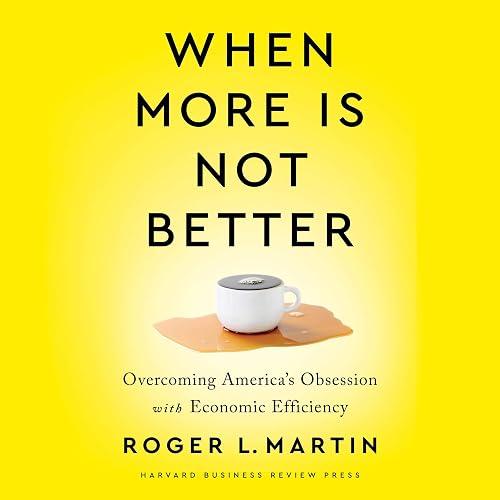
Book summary
Premium summary · Opens in the app · 30 min read
For nearly two and a half centuries, American democratic capitalism delivered a remarkable promise: work hard, play by the rules, and your life will be better than your parents' lives. This promise was not merely rhetorical. It was backed by consistent, measurable progress. Between 1947 and 1976, the median American family saw its income double. In less than three decades, the average family became twice as prosperous. This was the engine of the American Dream, and it ran with remarkable reliabi
**Author:** Roger L. Martin
**Estimated Reading Time:** 45 minutes
**What You'll Learn:**
- Why America's economic system stopped delivering for the majority of citizens - How the obsession with efficiency created fragility and inequality - What natural systems teach us about designing a more resilient economy - Practical strategies for business leaders, policymakers, educators, and citizens - A framework for balancing efficiency with resilience in every domain
**Who This Book Is For:**
This book is for anyone who senses that something fundamental has gone wrong with American democratic capitalism. It is for business leaders frustrated by short-term thinking, policymakers struggling to design effective regulations, educators preparing students for an unpredictable world, and citizens who want to understand why the system no longer seems to work for them. If you have wondered why economic growth no longer translates into broadly shared prosperity, or why institutions that once seemed stable now feel fragile, this book offers a diagnosis and a path forward.
For nearly two and a half centuries, American democratic capitalism delivered a remarkable promise: work hard, play by the rules, and your life will be better than your parents' lives. This promise was not merely rhetorical. It was backed by consistent, measurable progress. Between 1947 and 1976, the median American family saw its income double. In less than three decades, the average family became twice as prosperous. This was the engine of the American Dream, and it ran with remarkable reliability. Then something changed. In the forty-two years following the bicentennial, median family income grew by only 31 percent. To put that in perspective, the previous generation experienced 100 percent growth in just twenty-nine years. The median family was now only modestly better off after more than four decades of work. For the first time in American history, a generation could not confidently expect to live materially better than their parents. This stagnation did not affect everyone equally. While the median family struggled to make progress, the wealthiest Americans experienced unprecedented gains. The top 1 percent captured a growing share of economic growth. The top 0.1 percent did even better. The top 0.01 percent better still. The link between productivity growth and wage growth for ordinary workers, which had held for decades, broke down in the 1970s and never recovered. The consequences of this divergence extend far beyond economics. When a system consistently fails to deliver for the majority, the majority eventually questions the legitimacy of the system itself. Democratic capitalism relies on the consent of the governed. If most citizens conclude that the game is rigged against them, they may use their democratic power to choose a different game entirely. This vulnerability is arguably greater now than during the…
Continue reading in the MinuteRead app
Get the complete 30-minute summary of When More Is Not Better
Get the complete summary in the appThe economy is a complex adaptive system, not a machine. Treat it accordingly.
The efficiency obsession has created fragility, inequality, and systemic gaming. The pursuit of efficiency at the expens
Surrogation is the process by which a proxy for an outcome becomes a substitute for the outcome. Any measure that become
The shift from Gaussian to Pareto distributions means that a small number of winners capture most of the rewards. This u
Monocultures are efficient but fragile. Diversity is essential for resilience.
Gaming is inevitable in complex adaptive systems. The goal is not to eliminate gaming but to make value creation more at
"When More Is Not Better" is a strong fit if you want practical ideas around economics, business, politics, especially themes like the economy is a complex adaptive system, not a machine. treat it accordingly; the efficiency obsession has created fragility, inequality, and systemic gaming. the pursuit of efficiency at the expens. The MinuteRead summary distills these concepts into a focused read, whether you're deciding whether to buy the book or applying its lessons at work.
Motivated to help readers with in the forty-two years following the bicentennial, Roger L. Martin wrote “When More Is Not Better” to package those ideas for a fast, focused read. In “When More Is Not Better”, Roger L. Martin focuses on in the forty-two years following the bicentennial. Through “When More Is Not Better”, Roger L. Martin distills the core ideas on economics into lessons readers can absorb in a single short sitting. Readers turn to this work when they want Roger L. Martin's perspec…
View all summaries by Roger L. MartinContinue Reading
Access the complete 30-minute summary and thousands more nonfiction books in the MinuteRead app.

Continue reading the complete summary in the MinuteRead app.