MinuteRead
30 min
Book summary
by Steven Reiss
Premium summary · Opens in the app · 30 min read
Steven Reiss spent much of his early career as a conventional psychologist. He studied anxiety, conducted experiments, and published papers in academic journals. Then something happened that changed the direction of his life and his work.
**Author:** Steven Reiss
**Estimated Reading Time:** 45 minutes
**What You'll Learn:**
- Why pleasure and pain cannot fully explain human behavior - The 16 fundamental desires that drive every person - How to identify your own unique desire profile - Why value-based happiness matters more than feel-good happiness - How to improve relationships, career satisfaction, and self-understanding
**Who This Book Is For:**
Anyone who has ever wondered why they want what they want. Anyone who has felt misunderstood by others. Anyone seeking a deeper explanation for human behavior than simple reward and punishment. Anyone who wants to understand themselves, their partners, their children, or their colleagues at a more profound level.
Steven Reiss spent much of his early career as a conventional psychologist. He studied anxiety, conducted experiments, and published papers in academic journals. Then something happened that changed the direction of his life and his work. A serious illness forced him into a hospital bed. During his recovery, he had time to think about what makes life worth living. He realized that psychology had spent decades studying what goes wrong with people but had devoted far less attention to what makes life meaningful. He began asking a deceptively simple question: What do people really want? The answer, he discovered, was not simple at all. For much of the twentieth century, psychology operated under a dominant assumption. Human beings, the theory went, are motivated by the pursuit of pleasure and the avoidance of pain. We seek rewards. We avoid punishments. Everything else is just a variation on that theme. Reiss found this explanation deeply unsatisfying. It did not match what he observed in real life. Why would a parent sacrifice their own comfort for a child? Why would a soldier risk death for a principle? Why would an artist spend years perfecting a work that might never sell? Why would someone choose a difficult, meaningful life over an easy, pleasant one? The pleasure-pain model could not answer these questions convincingly. Reiss began a research program with his colleague Susan Havercamp. They surveyed thousands of people, asking them about what they valued, what they pursued, and what gave their lives meaning. They looked for patterns. They tested hypotheses. They refined their ideas over years of careful study. What emerged was a comprehensive framework of human motivation built on sixteen basic desires. These desires are not learned preferences or cultural values. They are intrinsic, biologically rooted motivations that every human being experiences to some degree. What makes each person unique is not which desires they have, but how strongly each desire manifests in their life. This book presents that framework. It explains what the sixteen desires are, how they shape behavior, and…
Continue reading in the MinuteRead app
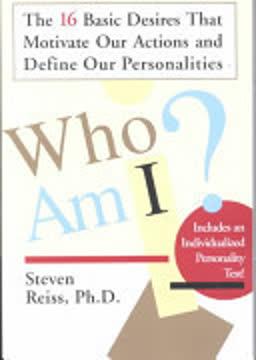
Get the complete 30-minute summary of Who Am I? The 16 Basic Desires That Motivate Our Actions and Define Our Personalities
Get the complete summary in the appHuman motivation is driven by sixteen basic desires, not just pleasure and pain.
Each person has a unique desire profile that shapes their personality and priorities.
True happiness comes from fulfilling your basic desires, not from chasing pleasure.
Curiosity is about enjoying learning, not about being smart.
Relationship compatibility depends on how well desire profiles align.
Most conflicts are rooted in underlying desire differences, not surface issues.
"Who Am I? The 16 Basic Desires That Motivate Our Actions and Define Our Personalities" is a strong fit if you want practical ideas around psychology, self help, management, especially themes like human motivation is driven by sixteen basic desires, not just pleasure and pain; each person has a unique desire profile that shapes their personality and priorities. The MinuteRead summary distills these concepts into a focused read, whether you're deciding whether to buy the book or applying its lessons at work.
Steven Reiss was a psychologist and researcher known for his work on human motivation and personality. He developed the theory of 16 basic desires after experiencing a life-threatening illness that prompted him to explore what makes life meaningful. Reiss conducted extensive research with colleague Susan Havercamp to identify and validate these core motivations. He argued that understanding these desires can help explain individual differences in behavior and improve relationships. Reiss authore…
View all summaries by Steven ReissContinue Reading
Access the complete 30-minute summary and thousands more nonfiction books in the MinuteRead app.

Continue reading the complete summary in the MinuteRead app.