MinuteRead
30 min
Book summary
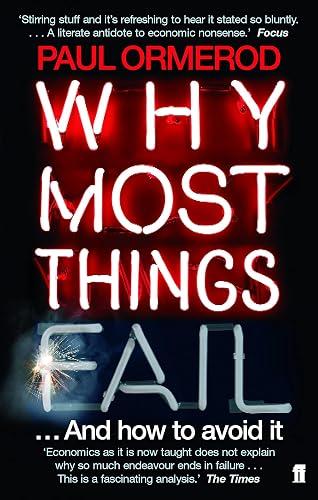
by Paul Ormerod
Premium summary · Opens in the app · 30 min read
In 1912, the world's hundred largest companies looked invincible. They controlled vast resources, employed armies of workers, and dominated their industries. They had the best managers, the best information, and the best strategies that money could buy. Yet by 1995, only twenty-eight of those hundred companies still existed as independent, growing enterprises. The rest had either gone bankrupt, been absorbed into other firms, or shrunk into irrelevance.
**Author:** Paul Ormerod **Estimated Reading Time:** 45 minutes
**What You'll Learn:**
Why extinction is the norm rather than the exception in biology, business, and society. You will discover why conventional economic models fail to predict real-world outcomes, how power laws govern failure patterns, and what this means for anyone making decisions in an uncertain world.
**Who This Book Is For:**
This book is for anyone who has ever wondered why well-planned strategies collapse, why successful companies vanish, or why experts so often get things wrong. It is for business leaders, policymakers, investors, and curious readers who want a deeper understanding of how complex systems actually behave.
In 1912, the world's hundred largest companies looked invincible. They controlled vast resources, employed armies of workers, and dominated their industries. They had the best managers, the best information, and the best strategies that money could buy. Yet by 1995, only twenty-eight of those hundred companies still existed as independent, growing enterprises. The rest had either gone bankrupt, been absorbed into other firms, or shrunk into irrelevance. This pattern is not an anomaly. It is the rule. Walk through any business cemetery and you will find the tombstones of companies that once seemed unassailable. Pan American World Airways, once the flagship carrier of American aviation, disappeared in 1991. Blockbuster, which dominated video rental for decades, collapsed under the weight of its own success. Lehman Brothers, founded in 1850, survived the Civil War, two world wars, and the Great Depression, only to vanish in a single weekend in 2008. The same pattern appears in the natural world. Of all the biological species that have ever existed on Earth, 99.9 percent are now extinct. The trilobites, the dinosaurs, the woolly mammoths: all gone. Extinction is not an occasional accident in nature. It is the default outcome. Paul Ormerod wrote *Why Most Things Fail* to confront an uncomfortable truth that most economists, business strategists, and policymakers prefer to ignore. We live in a world where failure is pervasive, where the connection between intention and outcome is far weaker than we like to believe, and where the very complexity of our systems makes prediction nearly impossible. The book emerged from a simple observation. Traditional economics, with its elegant models of rational actors and equilibrium, was failing to explain what was actually happening in the real world. The models predicted stability. Reality delivered chaos. The models assumed that well-informed decisions would lead to predictable outcomes. Reality showed that even the best-informed decisions often led to disaster. Ormerod's background made him uniquely positioned to see this disconnect. He had worked as an economic forecaster, a profession built on the premise that the future can be predicted with reasonable accuracy. He…
Continue reading in the MinuteRead app
Get the complete 30-minute summary of Why Most Things Fail
Get the complete summary in the appFailure is the norm in complex systems. Most species and most companies fail.
Intent does not guarantee outcome. Even the best plans can fail.
Power laws govern the patterns of failure. Extreme events are more common than you think.
The Iron Law of Failure: old firms fail at the same rate as young firms.
Learning has limits. Perfect knowledge is unattainable.
Creative destruction: failure at the individual level benefits the system as a whole.
"Why Most Things Fail" is a strong fit if you want practical ideas around economics, business, science, especially themes like failure is the norm in complex systems. most species and most companies fail; intent does not guarantee outcome. even the best plans can fail. The MinuteRead summary distills these concepts into a focused read, whether you're deciding whether to buy the book or applying its lessons at work.
Motivated to help readers with 1) Failure is pervasive and inevitable in complex systems 2) Intent does not guarantee outcome in, Paul Ormerod wrote “Why Most Things Fail” to package those ideas for a fast, focused read. In “Why Most Things Fail”, Paul Ormerod focuses on 1) Failure is pervasive and inevitable in complex systems 2) Intent does not guarantee outcome in. Through “Why Most Things Fail”, Paul Ormerod distills the core ideas on economics into lessons readers can absorb in a single sho…
Continue Reading
Access the complete 30-minute summary and thousands more nonfiction books in the MinuteRead app.

Continue reading the complete summary in the MinuteRead app.