MinuteRead
30 min
Book summary
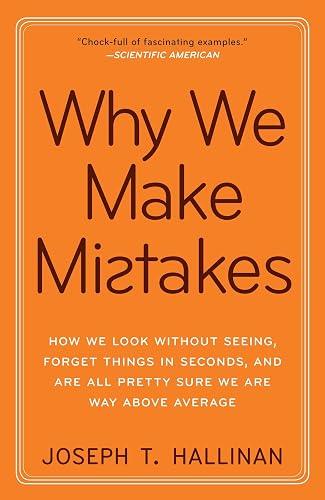
by Joseph T. Hallinan
Premium summary · Opens in the app · 30 min read
We like to think of ourselves as reliable witnesses to our own lives. We believe that when we look at something, we see what is there. We believe that our memories are accurate records of what happened. We believe that we make decisions based on careful consideration of the facts. We believe that we know our own abilities and limitations.
**Author:** Joseph T. Hallinan **Estimated Reading Time:** 45 minutes
Why do smart people make dumb mistakes? Why do we miss things that are right in front of us? Why do we remember events that never happened and forget things that did? This condensed edition of Joseph T. Hallinan's acclaimed book reveals the hidden forces that shape our errors, from the quirks of visual perception to the flaws in memory, from overconfidence to the surprising power of context. You will learn why mistakes are not random accidents but predictable patterns, and how understanding these patterns can help you make better decisions in every area of life.
This book is for anyone who has ever made a mistake and wondered why. It is for professionals who want to reduce errors in their work, for decision-makers who want to understand the hidden biases that shape their choices, for students who want to learn more effectively, and for anyone curious about the fascinating ways our minds work against us. If you have ever missed something obvious, remembered something incorrectly, or been too confident in a wrong answer, this book will explain what happened and show you how to avoid repeating the pattern.
We like to think of ourselves as reliable witnesses to our own lives. We believe that when we look at something, we see what is there. We believe that our memories are accurate records of what happened. We believe that we make decisions based on careful consideration of the facts. We believe that we know our own abilities and limitations. We are wrong about all of these things. Joseph T. Hallinan spent years investigating the science of human error, and what he discovered is both humbling and liberating. Humbling because it reveals just how often and how predictably we get things wrong. Liberating because once we understand the patterns behind our mistakes, we can begin to correct them. Consider a simple experiment conducted by researchers at Harvard University. They asked participants to watch a video of people passing basketballs and count the number of passes. In the middle of the video, a person in a gorilla suit walks through the scene, stops, beats its chest, and walks off. Astonishingly, about half of the viewers never see the gorilla. They are so focused on counting passes that they become blind to something that should be impossible to miss. This phenomenon, known as inattentional blindness, is not limited to laboratory experiments. It happens in real life, with real consequences. Radiologists searching for tumors have missed a gorilla image inserted into a lung scan. Pilots focused on a warning light have failed to notice another plane on the runway. Drivers talking on cell phones have…
Continue reading in the MinuteRead app
Get the complete 30-minute summary of Why We Make Mistakes
Get the complete summary in the app**You miss more than you think.** Attention is limited, and we routinely fail to notice things that should be impossible
**Your memory is not a recording.** It is a reconstruction, and it is systematically biased in your favor.
**You are overconfident.** Almost everyone is, and the least competent are often the most confident.
**Multitasking is a myth.** You are not doing two things at once; you are switching rapidly, and it costs you.
**Framing shapes decisions.** The way a choice is presented matters as much as the choice itself.
**Experts have blind spots.** The same skills that make expertise possible can also cause experts to miss obvious detail
"Why We Make Mistakes" is a strong fit if you want practical ideas around psychology, science, self help, especially themes like **you miss more than you think.** attention is limited, and we routinely fail to notice things that should be impossible; **your memory is not a recording.** it is a reconstruction, and it is systematically biased in your favor. The MinuteRead summary distills these concepts into a focused read, whether you're deciding whether to buy the book or applying its lessons at work.
Motivated to help readers with "When we look at something—or at someone—we think we see all there is to see, Joseph T. Hallinan wrote “Why We Make Mistakes” to package those ideas for a fast, focused read. In “Why We Make Mistakes”, Joseph T. Hallinan focuses on "When we look at something—or at someone—we think we see all there is to see. Through “Why We Make Mistakes”, Joseph T. Hallinan distills the core ideas on psychology into lessons readers can absorb in a single short sitting. Readers tur…
Continue Reading
Access the complete 30-minute summary and thousands more nonfiction books in the MinuteRead app.

Continue reading the complete summary in the MinuteRead app.