MinuteRead
30 min
Book summary
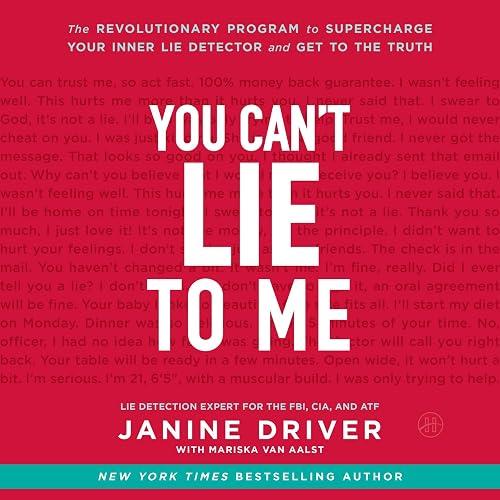
by Janine Driver
Premium summary · Opens in the app · 30 min read
Every day, you make decisions based on what other people tell you. You trust a mechanic who says your transmission needs replacing. You believe a colleague who promises the project will be finished by Friday. You accept a partner's explanation for why they came home late. You take a salesperson's word that this is the best price you'll find anywhere.
**Author:** Janine Driver
**Estimated Reading Time:** 45 minutes
**What You'll Learn:** How to build a reliable deception detection system using the BS Barometer, a five-step framework that combines intuition, verbal analysis, facial cues, body language, and strategic questioning. You'll discover why trusting people make better lie detectors, how power dynamics influence honesty, and how to turn these skills inward to live a more authentic life.
**Who This Book Is For:** Anyone who wants to make better decisions about whom to trust. Whether you're navigating a difficult conversation with a partner, evaluating a business deal, interviewing a job candidate, or simply tired of being taken advantage of, this book gives you practical tools to see past deception without becoming cynical.
Every day, you make decisions based on what other people tell you. You trust a mechanic who says your transmission needs replacing. You believe a colleague who promises the project will be finished by Friday. You accept a partner's explanation for why they came home late. You take a salesperson's word that this is the best price you'll find anywhere. Most of the time, these small acts of trust work out fine. But when they don't, the consequences can range from mildly annoying to genuinely devastating. A bad hire costs a company thousands. A dishonest partner wastes years of your life. A fraudulent investment destroys your savings. A lying employee exposes your business to legal risk. The problem is that most people are terrible at detecting deception. Decades of research consistently shows that the average person can spot a lie only slightly better than random chance. Even trained professionals, police officers, judges, customs agents, and therapists, often perform no better than a coin flip when asked to determine whether someone is telling the truth. Why is this? Part of the problem is that we're taught the wrong things to look for. We believe liars avoid eye contact, fidget nervously, and touch their faces. We think shifty eyes and sweaty palms give people away. But these folk wisdom beliefs are not just unreliable, they actively make us worse at detecting lies. Real liars often look us straight in the eye. They may sit perfectly still. They've learned to control the very signals we've been told to watch for. Janine Driver knows this territory intimately. She spent years working with federal law enforcement, training agents at the FBI, CIA, and ATF in deception detection. She's interviewed suspects, analyzed statements, and taught investigators how to separate truth from lies in high-stakes situations. But her most important insight isn't about catching criminals. It's about everyday life. Driver's central argument is both counterintuitive and liberating: the best lie detectors are not cynical skeptics who assume everyone…
Continue reading in the MinuteRead app
Get the complete 30-minute summary of You Can't Lie to Me
Get the complete summary in the appTrust your gut, but verify with the BS Barometer. Intuition is a starting point, not a conclusion.
Establish a baseline before evaluating honesty. You can't spot deviations from normal if you don't know what normal look
Listen to words more carefully than you watch body language. Verbal analysis is often more accurate.
Watch for microexpressions, those fleeting facial changes that reveal hidden emotions.
Pay attention to power dynamics. Powerful people lie differently than powerless people.
Emotional investment is the biggest predictor of deception detection success. Care about the outcome.
"You Can't Lie to Me" is a strong fit if you want practical ideas around psychology, self help, business, especially themes like trust your gut, but verify with the bs barometer. intuition is a starting point, not a conclusion; establish a baseline before evaluating honesty. you can't spot deviations from normal if you don't know what normal look. The MinuteRead summary distills these concepts into a focused read, whether you're deciding whether to buy the book or applying its lessons at work.
Motivated to help readers with because here’s the secret: more trusting people make better lie detectors, Janine Driver wrote “You Can't Lie to Me” to package those ideas for a fast, focused read. In “You Can't Lie to Me”, Janine Driver focuses on because here’s the secret: more trusting people make better lie detectors. Through “You Can't Lie to Me”, Janine Driver distills the core ideas on psychology into lessons readers can absorb in a single short sitting. Readers turn to this work when they…
Continue Reading
Access the complete 30-minute summary and thousands more nonfiction books in the MinuteRead app.

Continue reading the complete summary in the MinuteRead app.