MinuteRead
30 min
Book summary
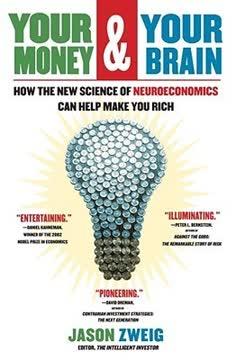
by Jason Zweig
Premium summary · Opens in the app · 30 min read
Every day, millions of people make financial decisions they know they should not make. They buy stocks at the peak of euphoria. They sell in panic at the bottom. They chase investments that have already soared, convinced the trend will continue forever. They hold losing positions for years, unable to admit a mistake. They check their portfolios obsessively, trade too often, and pay too much in fees and taxes.
**Author:** Jason Zweig
**Estimated Reading Time:** 45 minutes
**What You'll Learn:**
- Why your brain is wired to make poor financial decisions - How emotions like greed, fear, and regret hijack your investing - The neuroscience behind overconfidence and the illusion of control - Practical strategies to harness your brain's tendencies for better outcomes - How to align your money with genuine happiness
**Who This Book Is For:**
Anyone who has ever made a financial decision they later regretted. Anyone who has watched a stock soar after selling too soon or held a losing investment far too long. Anyone who wants to understand why smart people make foolish money choices and how to stop repeating those mistakes.
Every day, millions of people make financial decisions they know they should not make. They buy stocks at the peak of euphoria. They sell in panic at the bottom. They chase investments that have already soared, convinced the trend will continue forever. They hold losing positions for years, unable to admit a mistake. They check their portfolios obsessively, trade too often, and pay too much in fees and taxes. Why does this happen? Why do intelligent, educated, successful people repeatedly sabotage their own financial futures? For decades, economists assumed that people acted rationally with money. The prevailing theory held that investors weighed probabilities, calculated risks, and made decisions that maximized their expected returns. But this theory had a problem: almost nobody actually behaved that way. Then came a revolution. Researchers began peering inside the human brain while people made financial decisions. What they discovered was startling. The brain does not process money as an abstract mathematical concept. It processes money through the same neural circuits that respond to food, sex, and physical danger. The brain treats a falling stock market like a charging predator. It treats a potential gain like a delicious meal. It treats the thrill of speculation like a drug. Jason Zweig, a financial journalist with decades of experience covering markets and investor behavior, recognized that this research held profound implications for ordinary people. The problem was not that investors lacked information. The problem was that their brains were not designed for modern financial markets. The human brain evolved over millions of years to help our ancestors survive on the savanna. It developed lightning-fast responses to immediate threats and rewards. It learned to recognize patterns, avoid danger, and seek pleasure. These adaptations served our ancestors well. But they are poorly suited to a world of stock tickers, retirement accounts, and complex financial instruments. The stock market is not a predator you can fight or flee. It is not a berry bush you can harvest. It is an abstract system of prices,…
Continue reading in the MinuteRead app
Get the complete 30-minute summary of Your Money and Your Brain
Get the complete summary in the appYour brain is not designed for investing; it evolved for survival on the savanna.
The anticipation of gain is often more pleasurable than the gain itself.
Your brain seeks patterns even in random data, creating the illusion of predictability.
Overconfidence is universal and invisible to those who suffer from it.
Losses feel more intense than equivalent gains, shaping your decisions in ways you may not recognize.
Financial losses activate the same brain regions as physical danger.
"Your Money and Your Brain" is a strong fit if you want practical ideas around finance, psychology, money, especially themes like your brain is not designed for investing; it evolved for survival on the savanna; the anticipation of gain is often more pleasurable than the gain itself. The MinuteRead summary distills these concepts into a focused read, whether you're deciding whether to buy the book or applying its lessons at work.
Jason Zweig is a respected financial journalist and columnist for The Wall Street Journal, specializing in investing and personal finance. With over 30 years of experience in financial journalism, Zweig has established himself as an authority in behavioral finance and neuroeconomics. He is known for his ability to explain complex financial concepts in accessible language. Zweig's work often focuses on helping investors avoid common psychological pitfalls and make better financial decisions. He h…
View all summaries by Jason ZweigContinue Reading
Access the complete 30-minute summary and thousands more nonfiction books in the MinuteRead app.

Continue reading the complete summary in the MinuteRead app.