MinuteRead
30 min
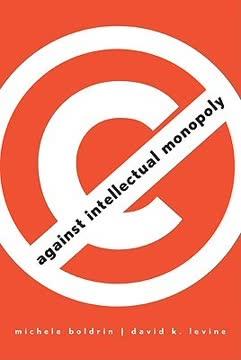
Book summary
Premium summary · Opens in the app · 30 min read
Every society that has ever achieved sustained economic growth has done so on the back of new ideas. The steam engine, electricity, antibiotics, the semiconductor, the internet: these innovations transformed human existence in ways that would have been unimaginable to previous generations. The question of how to encourage such innovation has occupied economists, philosophers, and policymakers for centuries. And for the past two hundred years, one answer has dominated all others: grant inventors
**Author:** Michele Boldrin and David K. Levine
**Estimated Reading Time:** 45 minutes
**What You'll Learn:** Why the conventional wisdom about patents and copyrights is wrong, how innovation actually happens in competitive markets, and what a world without intellectual monopoly would look like.
**Who This Book Is For:** Entrepreneurs, policymakers, creators, technologists, and anyone who has ever wondered whether intellectual property laws actually serve the public good.
Every society that has ever achieved sustained economic growth has done so on the back of new ideas. The steam engine, electricity, antibiotics, the semiconductor, the internet: these innovations transformed human existence in ways that would have been unimaginable to previous generations. The question of how to encourage such innovation has occupied economists, philosophers, and policymakers for centuries. And for the past two hundred years, one answer has dominated all others: grant inventors and creators exclusive rights to their ideas through patents and copyrights. The logic seems unassailable. Innovation is expensive. Copying is cheap. If anyone can freely copy a new invention or a new book, the argument goes, no one will bother to invent or write in the first place. The patent and copyright system exists to solve this problem by giving creators a temporary monopoly over their work, allowing them to recoup their investment and earn a profit. Without such protection, we are told, innovation would grind to a halt. This story is so deeply embedded in our culture that it is rarely questioned. It appears in textbooks, in policy debates, in corporate boardrooms, and in casual conversation. It has been used to justify ever-longer copyright terms, ever-broader patent protections, and ever-more-aggressive enforcement of intellectual property rights around the world. It is, in many ways, the founding myth of the modern knowledge economy. But what if this story is wrong? What if the patent and copyright system, far from being the engine of innovation, is actually a brake on it? What if the historical evidence shows that innovation thrives precisely when ideas are free to circulate, when competitors are free to improve upon each other's work, and when no one holds a monopoly over the building blocks of progress? This is the argument at the heart of *Against Intellectual Monopoly*, and it is an argument that challenges two centuries of accumulated assumptions. Michele Boldrin and David K. Levine, both academic economists with decades of research between them, have assembled a devastating case against the intellectual property system. Their conclusion is stark: intellectual monopoly is not a cause of innovation but an unwelcome consequence of it. Patents and copyrights do not create new ideas; they merely allow some people to profit from restricting access to ideas that would have emerged anyway. The implications…
Continue reading in the MinuteRead app
Get the complete 30-minute summary of Against Intellectual Monopoly
Get the complete summary in the appIntellectual property is not necessary for innovation. In most cases, it actively harms innovation by creating monopolie
Ideas are non-rivalrous. My use of an idea does not prevent you from using it. Intellectual property imposes artificial
Simultaneous invention is common. When the time is right, multiple people will independently arrive at the same insight.
The most innovative periods in history have often been those with the weakest intellectual property protections.
The software industry thrived without patents. Its most innovative period occurred before software patents became widesp
Open-source software demonstrates that innovation can thrive without intellectual property. It has produced some of the
"Against Intellectual Monopoly" is a strong fit if you want practical ideas around economics, law, politics, especially themes like intellectual property is not necessary for innovation. in most cases, it actively harms innovation by creating monopolie; ideas are non-rivalrous. my use of an idea does not prevent you from using it. intellectual property imposes artificial. The MinuteRead summary distills these concepts into a focused read, whether you're deciding whether to buy the book or applying its lessons at work.
Michele Boldrin is an Italian-born economist and professor known for his work on economic growth, innovation, and intellectual property. He co-authored "Against Intellectual Monopoly" with David K. Levine, challenging conventional wisdom on patents and copyrights. Boldrin's research focuses on macroeconomics, economic theory, and technological progress. He has held positions at prestigious institutions, including Washington University in St. Louis and the Federal Reserve Bank of St. Louis. Boldr…
View all summaries by Michele BoldrinContinue Reading
Access the complete 30-minute summary and thousands more nonfiction books in the MinuteRead app.

Continue reading the complete summary in the MinuteRead app.