MinuteRead
30 min
Book summary
Premium summary · Opens in the app · 30 min read
Every few decades, a technology emerges that fundamentally changes how businesses operate. Electricity did it. The internet did it. And now artificial intelligence is doing it again. Yet here is the uncomfortable truth: most companies are not ready for this moment.
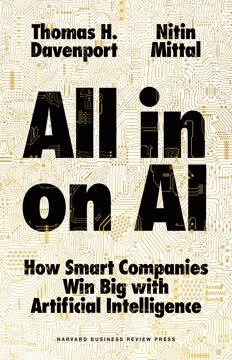
**How Smart Companies Win Big with Artificial Intelligence**
By Thomas H. Davenport
**Estimated Reading Time:** 45 minutes
**What You'll Learn**
Why fewer than 1 percent of large companies have truly transformed themselves with artificial intelligence, what separates these AI-fueled organizations from everyone else, and how leaders can build the capabilities, culture, and strategies required to join their ranks.
**Who This Book Is For**
Executives and managers who want to move beyond AI experimentation and into enterprise-wide transformation. Business leaders who suspect their organizations are falling behind. Anyone who wants to understand what full commitment to AI actually looks like in practice, not just in theory.
Every few decades, a technology emerges that fundamentally changes how businesses operate. Electricity did it. The internet did it. And now artificial intelligence is doing it again. Yet here is the uncomfortable truth: most companies are not ready for this moment. Thomas Davenport has spent decades studying how organizations adopt new technologies. He has watched waves of innovation come and go. He has seen companies embrace change and companies resist it. And in his research on artificial intelligence, he has discovered something striking. The gap between companies that truly commit to AI and everyone else is not small. It is enormous. Fewer than 1 percent of large companies qualify as what Davenport calls AI-fueled organizations. These are companies that have moved beyond pilot projects and experimentation. They have embedded AI into their core operations. They use it to make decisions, serve customers, manage risk, and create new products. For them, AI is not a tool. It is the foundation of how they work. The rest are stuck somewhere along the journey. Some are experimenting. Some are dabbling. Some have invested millions in AI initiatives that never made it into production. Some have hired data scientists who spend their time building models that nobody uses. Some have leadership teams that talk about AI but do not understand it well enough to drive real change. This book exists because that gap matters. It matters for companies that want to compete in industries being reshaped by intelligent systems. It matters for leaders who sense that their organizations are falling behind but do not know how to catch up. It matters for anyone who wants to understand what genuine AI transformation looks like from the inside. The challenge is not primarily technological. The technology exists. The algorithms are powerful. The cloud infrastructure is available. The data is often already there, waiting to be used. The real challenge is organizational. It is about leadership, culture, strategy, talent, and the willingness to rethink how work gets done. Davenport's approach is different because he does not deal in hype. He does not…
Continue reading in the MinuteRead app
Get the complete 30-minute summary of All-in On AI
Get the complete summary in the appAI-fueled organizations are rare, comprising less than 1 percent of large companies.
Broad enterprise adoption, production deployment, process reengineering, workforce fluency, and long-term commitment def
Leadership commitment and cultural readiness are the foundation of successful AI adoption.
AI enables three strategic approaches: creating something new, transforming operations, and influencing customer behavio
Data quality and cloud infrastructure are essential prerequisites for AI success.
AI augments human capabilities rather than replacing them. The best results come from human-AI collaboration.
"All-in On AI" is a strong fit if you want practical ideas around artificial intelligence, business, technology, especially themes like ai-fueled organizations are rare, comprising less than 1 percent of large companies; broad enterprise adoption, production deployment, process reengineering, workforce fluency, and long-term commitment def. The MinuteRead summary distills these concepts into a focused read, whether you're deciding whether to buy the book or applying its lessons at work.
Thomas H. Davenport is a prominent academic and author specializing in information technology and management. He holds the President's Chair at Babson College and has authored numerous influential books on business topics such as analytics, knowledge management, and process reengineering. Davenport's work has been published in various prestigious journals and publications. With a background in research, he has led research centers at major consulting firms. Davenport holds a Ph.D. in sociology f…
View all summaries by Thomas H. DavenportContinue Reading
Access the complete 30-minute summary and thousands more nonfiction books in the MinuteRead app.

Continue reading the complete summary in the MinuteRead app.