MinuteRead
30 min
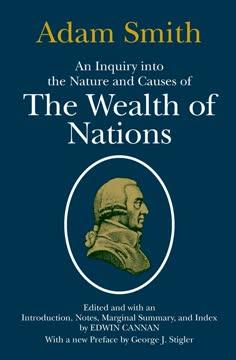
Book summary
by Adam Smith
Premium summary · Opens in the app · 30 min read
In 1776, as the American colonies declared their independence, a Scottish philosopher published a book that would declare independence for economic thought itself. Adam Smith's An Inquiry into the Nature and Causes of the Wealth of Nations did not merely describe how economies worked. It fundamentally changed how people understood the creation of prosperity.
**Author:** Adam Smith
**Estimated Reading Time:** 45 minutes
**What You'll Learn:**
The fundamental mechanics of how nations create wealth, why specialization transforms productivity, how markets coordinate human activity without central direction, and what truly determines the value of goods and services.
**Who This Book Is For:**
Anyone who wants to understand the foundational ideas of modern economics, from curious readers encountering Smith for the first time to experienced professionals seeking a deeper grasp of the principles that still shape markets, trade, and prosperity today.
In 1776, as the American colonies declared their independence, a Scottish philosopher published a book that would declare independence for economic thought itself. Adam Smith's An Inquiry into the Nature and Causes of the Wealth of Nations did not merely describe how economies worked. It fundamentally changed how people understood the creation of prosperity. Before Smith, wealth was largely understood as a static quantity. Nations accumulated gold and silver. Kings hoarded treasure. Mercantilist policies treated trade as a zero-sum competition where one nation's gain was another's loss. The prevailing assumption was that the world contained a fixed amount of wealth, and the goal of economic policy was to capture as much of it as possible. Smith saw something entirely different. He observed that wealth was not a fixed pile of metal but a dynamic process of production and exchange. Nations did not become rich by hoarding. They became rich by producing. The true measure of a nation's wealth was not the gold in its treasury but the goods and services available to its people. A rich nation was one where ordinary citizens could enjoy the necessities, conveniences, and amusements of life. This insight seems obvious today only because Smith's ideas have so thoroughly shaped modern thinking. But in his time, it was revolutionary. The question that drove Smith's inquiry was deceptively simple: Why are some nations wealthy while others remain poor? What explains the enormous differences in living standards across countries and across centuries? His answer began with an observation about a pin factory. Smith noticed that when the production of pins was broken down into distinct operations, each performed by a specialized worker, the output was astonishing. Ten workers, each performing a small part of the process, could produce tens of thousands of pins in a day. A single worker attempting to make pins alone might produce barely one. This was the division of labor, and Smith identified it as the primary engine of economic progress. When people specialize, they become more skilled at their particular tasks. They waste less time switching between activities. They invent better tools and methods. The result is an explosion in productive capacity. But specialization creates a problem. A pin…
Continue reading in the MinuteRead app
Get the complete 30-minute summary of An Inquiry into the Nature and Causes of the Wealth of Nations
Get the complete summary in the appThe division of labor is the primary driver of productivity and wealth creation.
Exchange enables specialization, and both parties benefit from voluntary trade.
Labor is the true measure of economic value, not gold or silver.
Money emerged to solve the limitations of barter and facilitate exchange.
Price is composed of wages, profit, and rent, representing labor, capital, and land.
Market prices fluctuate around natural prices based on supply and demand.
"An Inquiry into the Nature and Causes of the Wealth of Nations" is a strong fit if you want practical ideas around economics, philosophy, classics, especially themes like the division of labor is the primary driver of productivity and wealth creation; exchange enables specialization, and both parties benefit from voluntary trade. The MinuteRead summary distills these concepts into a focused read, whether you're deciding whether to buy the book or applying its lessons at work.
Adam Smith FRSA FRS FRSE was a Scottish philosopher and economist born in 1723. He played a crucial role in the Scottish Enlightenment and is renowned for his contributions to political economy. Smith authored two seminal works: The Theory of Moral Sentiments and An Inquiry into the Nature and Causes of the Wealth of Nations. The latter, often called The Wealth of Nations, is considered his magnum opus and the first modern treatise on economics as a comprehensive academic discipline. Smith's ide…
View all summaries by Adam SmithContinue Reading
Access the complete 30-minute summary and thousands more nonfiction books in the MinuteRead app.

Continue reading the complete summary in the MinuteRead app.