MinuteRead
30 min
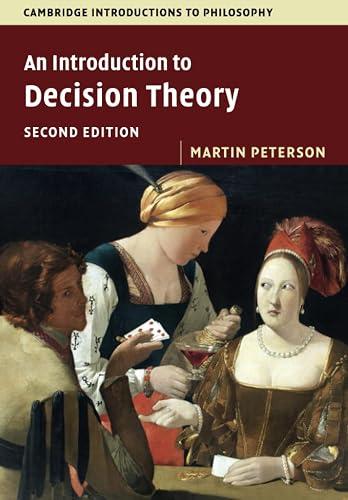
Book summary
by Martin Peterson
Premium summary · Opens in the app · 30 min read
Every day you make decisions. Some are trivial: what to eat for breakfast, which route to take to work, whether to bring an umbrella. Others carry weight: which job to accept, whether to invest in a new business, how to respond to a medical diagnosis. In each case, you face a fundamental challenge. You must choose among actions whose outcomes are uncertain, and you must do so in a way that aligns with your values, your beliefs, and your goals.
**Author:** Martin Peterson
**Estimated Reading Time:** 45 minutes
**What You'll Learn:**
- The foundational principles of rational decision making under uncertainty - How probability works and why its interpretation matters - The expected utility principle and how to apply it - How game theory reveals the logic of strategic interaction - Why individual rationality sometimes conflicts with collective good - The role of risk aversion, Bayesian reasoning, and causal thinking in decisions
**Who This Book Is For:**
Anyone who makes decisions. That includes you. Whether you are a student of philosophy, economics, or psychology, a professional navigating complex choices, or simply someone who wants to think more clearly about the tradeoffs that shape your life, this book offers a rigorous yet accessible introduction to the science and philosophy of rational choice.
Every day you make decisions. Some are trivial: what to eat for breakfast, which route to take to work, whether to bring an umbrella. Others carry weight: which job to accept, whether to invest in a new business, how to respond to a medical diagnosis. In each case, you face a fundamental challenge. You must choose among actions whose outcomes are uncertain, and you must do so in a way that aligns with your values, your beliefs, and your goals. This challenge is not new. Philosophers, mathematicians, economists, and psychologists have grappled with it for centuries. Yet the systematic study of how rational agents ought to make decisions only crystallized into a formal discipline in the twentieth century. That discipline is decision theory. Decision theory is the theory of rational decision making. It provides a structured framework for thinking about choices under conditions of uncertainty, where the consequences of your actions depend on factors you cannot fully control or predict. It asks a deceptively simple question: What does it mean to choose rationally? The answer is more complex than it first appears. To choose rationally, you must understand what your options are. You must assess how likely different outcomes are. You must evaluate how desirable those outcomes would be. And you must combine these assessments into a coherent choice. Each of these steps raises profound philosophical questions. What is probability? Is it a feature of the world, a measure of your ignorance, or a reflection of your subjective beliefs? What is utility? Is it a psychological state, a measure of preference satisfaction, or something else entirely? And what does it mean to be rational? Is rationality about maximizing expected value, avoiding regret, or something more nuanced? These questions are not merely academic. They have practical consequences. Consider a doctor deciding whether to recommend a risky surgery. She must weigh the probability of success against the severity of the patient's…
Continue reading in the MinuteRead app
Get the complete 30-minute summary of An Introduction to Decision Theory
Get the complete summary in the appRational decision making is about maximizing expected utility, not expected monetary value.
Probability has multiple interpretations, and understanding them is essential for rational choice.
The expected utility principle provides a systematic framework for decisions under uncertainty.
Risk aversion is rational and comes in multiple varieties.
Bayes' theorem tells you how to update beliefs in light of new evidence.
Base rates matter: Always start with the prior probability.
"An Introduction to Decision Theory" is a strong fit if you want practical ideas around philosophy, mathematics, economics, especially themes like rational decision making is about maximizing expected utility, not expected monetary value; probability has multiple interpretations, and understanding them is essential for rational choice. The MinuteRead summary distills these concepts into a focused read, whether you're deciding whether to buy the book or applying its lessons at work.
Motivated to help readers with "Decision theory is the theory of rational decision making." Fundamental Challenge of Decision Making, Martin Peterson wrote “An Introduction to Decision Theory” to package those ideas for a fast, focused read. In “An Introduction to Decision Theory”, Martin Peterson focuses on "Decision theory is the theory of rational decision making." Fundamental Challenge of Decision Making. Through “An Introduction to Decision Theory”, Martin Peterson distills the core ideas o…
Continue Reading
Access the complete 30-minute summary and thousands more nonfiction books in the MinuteRead app.

Continue reading the complete summary in the MinuteRead app.