MinuteRead
30 min
Book summary
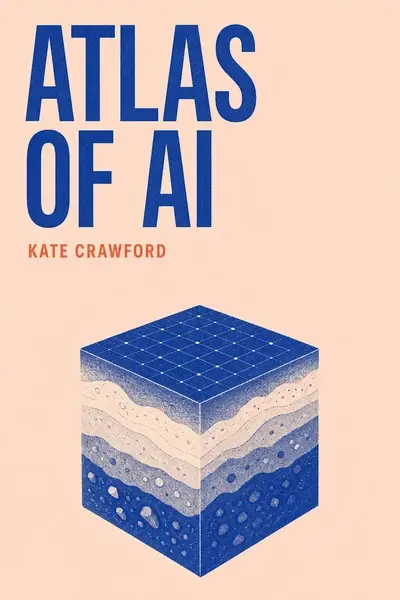
by Kate Crawford
Premium summary · Opens in the app · 30 min read
Artificial intelligence is usually described as something ethereal. We hear about algorithms that learn, neural networks that think, systems that transcend human limitations. The language suggests weightlessness, a realm of pure computation floating above the messy realities of daily life. Kate Crawford's Atlas of AI dismantles this fantasy with precision and force.
**Author:** Kate Crawford **Estimated Reading Time:** 45 minutes
The true material, environmental, and human costs behind artificial intelligence. How data extraction, labor exploitation, and concentrated corporate power shape the AI systems that increasingly govern modern life. Why the stories we tell about AI as inevitable progress obscure deeper structures of inequality and extraction.
Anyone who uses technology and wants to understand what powers it. Readers who sense that the promises of artificial intelligence come with unexamined costs. People working in technology, policy, education, and activism who need a clearer picture of how AI actually operates in the world.
Artificial intelligence is usually described as something ethereal. We hear about algorithms that learn, neural networks that think, systems that transcend human limitations. The language suggests weightlessness, a realm of pure computation floating above the messy realities of daily life. Kate Crawford's Atlas of AI dismantles this fantasy with precision and force. The book begins with a simple observation that changes everything. Artificial intelligence is not abstract. It is not immaterial. It is not a disembodied intelligence hovering in the cloud. It is a physical infrastructure built from the earth itself. Lithium from Nevada. Rare earth minerals from Inner Mongolia. Oil and gas powering vast data centers. Human hands labeling millions of images. Human minds filtering traumatic content. Human bodies moving through warehouses under algorithmic surveillance. Crawford argues that we have been looking at AI from the wrong angle. We focus on the outputs: the chatbot responses, the facial recognition matches, the recommendation engines. We marvel at the apparent intelligence while ignoring the extractive systems that make it possible. This book is an atlas because it maps those hidden territories. It traces the supply chains, the labor practices, the data harvesting, and the political structures that underpin the technology we have come to accept as inevitable. The stakes are enormous. AI systems now influence who gets hired, who gets loans, who gets policed, who gets seen. They shape what we read, what we buy, what we believe. They consume resources at a scale that rivals entire industries. They concentrate power in the hands of a few corporations while distributing harms across the planet. Yet most public discussion remains trapped in narrow debates about bias or accuracy, as if these systems could be fixed with better data or cleaner code. Crawford's intervention is to shift the conversation entirely. She asks us to see AI as an industry, not just a technology. An industry with mines and refineries. An industry with workers and bosses. An industry with winners and losers. An industry with a history, shaped by military priorities and corporate ambitions. An industry with environmental consequences that will outlast any particular product or…
Continue reading in the MinuteRead app
Get the complete 30-minute summary of Atlas of AI
Get the complete summary in the appAI is an extractive industry, not an abstract technology.
The minerals and energy required for AI come from environmentally destructive mining and fossil fuel extraction.
AI depends on hidden human labor that is poorly compensated and intensely surveilled.
Training data is harvested from human lives without meaningful consent.
The categories used in AI reflect the biases of their creators and produce discriminatory outcomes.
Affect recognition is based on contested science and should not be trusted in high-stakes decisions.
"Atlas of AI" is a strong fit if you want practical ideas around artificial intelligence, technology, science, especially themes like ai is an extractive industry, not an abstract technology; the minerals and energy required for ai come from environmentally destructive mining and fossil fuel extraction. The MinuteRead summary distills these concepts into a focused read, whether you're deciding whether to buy the book or applying its lessons at work.
Motivated to help readers with computational media now participate in geological (and climatological) processes, Kate Crawford wrote “Atlas of AI” to package those ideas for a fast, focused read. In “Atlas of AI”, Kate Crawford focuses on computational media now participate in geological (and climatological) processes. Through “Atlas of AI”, Kate Crawford distills the core ideas on artificial intelligence into lessons readers can absorb in a single short sitting. Readers turn to this work when t…
Continue Reading
Access the complete 30-minute summary and thousands more nonfiction books in the MinuteRead app.

Continue reading the complete summary in the MinuteRead app.