MinuteRead
30 min
Book summary
Premium summary · Opens in the app · 30 min read
Every few decades, a technology emerges that does not merely improve how businesses operate but fundamentally changes what a business can be. The steam engine did this in the nineteenth century. Electricity did it in the twentieth. The internet did it at the turn of the millennium. Artificial intelligence is doing it now.
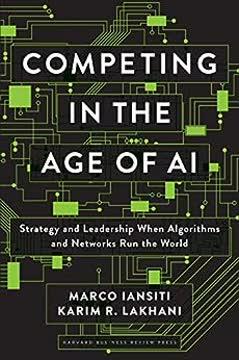
**Author:** Marco Iansiti with Karim R. Lakhani
**Estimated Reading Time:** 45 minutes
**What You'll Learn:** How artificial intelligence is fundamentally reshaping business models, why traditional firms are vulnerable to AI-powered competitors, and what leaders must do to transform their organizations for the age of intelligent systems.
**Who This Book Is For:** Executives navigating digital transformation, entrepreneurs building AI-native companies, investors evaluating technology businesses, and anyone seeking to understand why some firms scale with unprecedented speed while others collapse under their own complexity.
Every few decades, a technology emerges that does not merely improve how businesses operate but fundamentally changes what a business can be. The steam engine did this in the nineteenth century. Electricity did it in the twentieth. The internet did it at the turn of the millennium. Artificial intelligence is doing it now. But the story of AI is not the story of robots replacing humans. It is not about machines that think like people or software that mimics consciousness. The real story is both subtler and more consequential. AI is giving rise to a new type of firm, one that operates on principles fundamentally different from those that have governed business for centuries. Consider two companies in the financial services industry. A traditional bank serves customers through branches, employs thousands of loan officers, and makes lending decisions based on credit scores and human judgment. It takes weeks to approve a loan. It serves millions of customers, which is impressive. Then consider Ant Financial, the Chinese fintech company. It serves over a billion customers. It processes loan applications in minutes, not weeks. It makes lending decisions not through human judgment but through algorithms that analyze thousands of data points in real time. It employs a fraction of the people a traditional bank would need to serve a comparable customer base. And it does this while maintaining lower default rates than traditional lenders. The difference between these two organizations is not simply that one uses better technology. The difference is architectural. Ant Financial is built around what Iansiti and Lakhani call the AI factory, a scalable decision engine powered by software, data, and algorithms. This factory allows the firm to make millions of decisions daily, each one informed by data, each one improving the system that made it. This book explains why this architectural difference matters so much. It explains why AI-powered firms grow faster, scale further, and disrupt industries more thoroughly than traditional competitors. It explains why the collision between AI-native companies and conventional firms is reshaping markets in ways that surprise even seasoned observers. And it offers a path forward for leaders who recognize that incremental digital transformation is no longer enough. The challenge is urgent because…
Continue reading in the MinuteRead app
Get the complete 30-minute summary of Competing in the Age of AI
Get the complete summary in the appAI is not a tool. It is an operating model that fundamentally changes how firms create value.
The AI factory consists of the data pipeline, algorithm development, the experimentation platform, and software infrastr
Data network effects create compounding advantages that are extraordinarily difficult for competitors to overcome.
Rearchitecting a firm requires breaking down silos and creating integrated data platforms.
AI transformation takes years and requires sustained leadership commitment.
Strategic collisions between AI-powered and traditional firms are decisive, not incremental.
"Competing in the Age of AI" is a strong fit if you want practical ideas around artificial intelligence, business, technology, especially themes like ai is not a tool. it is an operating model that fundamentally changes how firms create value; the ai factory consists of the data pipeline, algorithm development, the experimentation platform, and software infrastr. The MinuteRead summary distills these concepts into a focused read, whether you're deciding whether to buy the book or applying its lessons at work.
Marco Iansiti is a Professor of Business Administration at Harvard Business School, specializing in Technology and Operations Management. He advises global companies on operational transition and technological transformation. Iansiti has authored numerous publications, including "Digital Ubiquity" and "The Keystone Advantage." His co-author, Karim R. Lakhani, is also a Business Administration Professor at Harvard Business School and serves as the co-director of the Laboratory of Innovation Scien…
View all summaries by Marco IansitiContinue Reading
Access the complete 30-minute summary and thousands more nonfiction books in the MinuteRead app.

Continue reading the complete summary in the MinuteRead app.