MinuteRead
30 min
Book summary
Premium summary · Opens in the app · 30 min read
Economics is the study of how people make choices under conditions of scarcity. That simple definition hides an enormous complexity. Every economic decision involves multiple actors, competing objectives, constraints, trade-offs, and feedback loops. Prices adjust. Quantities respond. Markets clear or fail to clear. Over time, economies grow, contract, and transform.
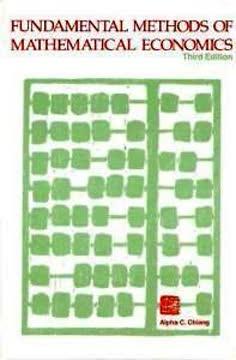
**Author:** Alpha C. Chiang
**Estimated Reading Time:** 90 minutes
**What You'll Learn:**
- Why mathematics provides a more powerful language for economic analysis than words alone - How to construct and solve economic models using equations, variables, and parameters - The essential tools of matrix algebra, calculus, and optimization as they apply to economics - How to analyze how changes in external conditions affect economic equilibrium - The foundations of dynamic analysis, linear programming, and general equilibrium theory
**Who This Book Is For:**
This condensed edition is for economics students who want to build genuine mathematical competence, professionals who need to refresh their analytical toolkit, and anyone curious about how economists translate real-world problems into solvable mathematical structures. No advanced mathematical background is assumed. What is required is a willingness to think carefully and to follow arguments step by step.
Economics is the study of how people make choices under conditions of scarcity. That simple definition hides an enormous complexity. Every economic decision involves multiple actors, competing objectives, constraints, trade-offs, and feedback loops. Prices adjust. Quantities respond. Markets clear or fail to clear. Over time, economies grow, contract, and transform. For much of its history, economics was conducted primarily through words. Economists wrote lengthy treatises explaining their reasoning in prose. They used verbal logic to move from assumptions to conclusions. This approach, which Alpha Chiang calls "literary economics," has produced many profound insights. But it has also imposed serious limitations on the discipline. The central problem is that words are imprecise. When an economist writes that "an increase in demand tends to raise prices," the reader is left wondering: How much? Under what conditions? What if supply also changes? What if there are multiple markets interacting simultaneously? Verbal reasoning becomes strained when the relationships under study grow complex. Mathematical economics offers a solution to this problem. It is not a separate branch of economics, but rather a method of analysis. It uses mathematical symbols instead of words, equations instead of sentences, and mathematical theorems instead of informal logic. This shift in language brings with it enormous advantages. Consider a simple example. In words, we might say: "The quantity of a good that consumers wish to purchase depends on the price of that good, the prices of related goods, consumer income, and consumer tastes." In mathematical notation, we write: Qd = f(P, Ps, Y, T) The mathematical expression is shorter, but that is not its primary virtue. Its true power lies in precision. The equation tells us exactly which variables matter. It tells us that quantity demanded is a function of specific factors. It invites us to ask precise questions about the nature of that function: Is it linear? Is it…
Continue reading in the MinuteRead app
Get the complete 30-minute summary of Fundamental Methods of Mathematical Economics
Get the complete summary in the appMathematical economics is a method of analysis, not a separate branch of economics.
Economic models are simplified representations of reality, built from variables, parameters, and equations.
Endogenous variables are determined within the model; exogenous variables are determined outside it.
Equilibrium is a state of rest where variables have no inherent tendency to change.
Comparative statics compares equilibrium states using derivatives to determine the direction of change.
Optimization problems are solved using first-order conditions to find critical points and second-order conditions to cla
"Fundamental Methods of Mathematical Economics" is a strong fit if you want practical ideas around economics, mathematics, textbooks, especially themes like mathematical economics is a method of analysis, not a separate branch of economics; economic models are simplified representations of reality, built from variables, parameters, and equations. The MinuteRead summary distills these concepts into a focused read, whether you're deciding whether to buy the book or applying its lessons at work.
Alpha C. Chiang is the author of "Fundamental Methods of Mathematical Economics," a widely used textbook in mathematical economics. Chiang is known for his ability to explain complex mathematical concepts clearly and patiently, making the subject accessible to students with varying levels of mathematical background. His approach is praised for being unpretentious and non-elitist, focusing on helping readers understand the practical applications of mathematics in economics. Chiang's work has been…
View all summaries by Alpha C. ChiangContinue Reading
Access the complete 30-minute summary and thousands more nonfiction books in the MinuteRead app.

Continue reading the complete summary in the MinuteRead app.